This page was translated by AI. Please be forgiving of any mistakes.
‹ Photo Notes · 15 ledna, 2012
 Somewhere on the internet I keep reading comments like: „That model is disgustingly anorexic! Someone should help her and not support it further by photographing her. Shame on you, Mr Photographer!“ and the like. Models are often grossly insulted, and because my close friends are labelled this way too, I would like to say something on the subject. I am perfectly aware of the futility of my effort, just as photographers‘ reactions under their photographs are futile. But a classic would say: „Stupidity must be fought continuously, even though it can’t be won„.
I like very slim women and I like photographing them. Anorexics, however, don’t attract me; if I wanted to photograph an anorexic, it would only be for the purpose of some very striking photograph and I wouldn’t try to present her as a role model but as a deterrent example.
I have met several anorexics in my life and felt sorry for them. In time I understood that it really isn’t easy to help them, because anorexics don’t believe you that they are anorexic. Perhaps the best thing I could ever say was „we’ll shoot when you get yourself together a bit„. Those I met who got out of anorexia had to figure it out themselves. Either they looked in the mirror and it finally told them the truth one day, or they collapsed and after one or two stays in hospital came to their senses.
As for obesity, we are far behind America, yet it has always done well in our countries too. Perhaps that is why here 10, 15 or even 20 kilograms of overweight is considered normal, but 5 kilograms of underweight is often contemptuously labelled anorexia. I even have personal experience with it; I was always one of the thinnest and was often laughed at because of it, yet I was never anorexic. I ate and eat normally, and only now, after forty, have I reached a normal weight that on average corresponds to my height (most of those who laughed at me are heavily overweight today). Our proportions deviate from genetic predispositions just as they do from our lifestyle.
Let’s return to models. I prepared a small example and chose Viktoria for it, one of my most popular models and at the same time one of my best friends, who by coincidence has a birthday today (:-*). Because I have photographed Viktorka about a million times, I know how extremely slim she is in summer, without a gram of extra fat, and how she inconspicuously rounds out around Christmas (which, last Christmas, happened to me for the first time in my life too 🙂 and with every fasting week returns to her usual weight. She received the genetic gift of a beautifully delicate figure and you can also recognize muscles drawn by sport. I know her at the dinner table too, and when I see her eat, I never have the slightest worry about her health.
With the following example I want to show that you can’t believe everything you see, let alone judge someone unjustly.
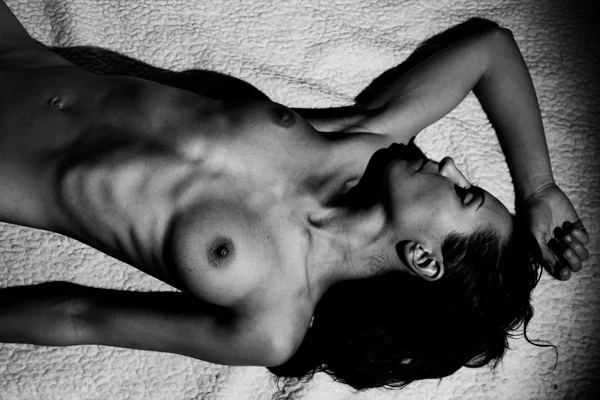
Photography has something in common with illusionism. As a photographer I try to make the viewer see exactly what I want, and I help myself with various means. I won’t go on at length about everything I have at my disposal, I’ll focus only on light and contrast. If, for example, I light with soft light as perpendicular to the body as possible, I create a soft, sometimes curd-like mass without shadows (and atmosphere). If I use sharper light and aim it more from the side, shadows, God forbid, begin to appear, created by the uneven surface of our bodies, and ribs, vertebrae, collarbones come out, as well as a pronounced drawing of the muscles, if the model has them. When I add contrast, everything stands out even more, and from a normally slim model I create a collection of bones, tendons and muscles.
Compare one photograph, edited in two ways. The first edit is gentle, using low contrast. The model’s ribs are slightly visible, also because, although you can’t see it, she isn’t lying the way I would, say, lie down on a couch; her back forms an arched curve and touches the surface only with her shoulders, shoulder blades and lower back – in such a position the ribs show on anyone who isn’t heavily overweight. Still, the figure here gives the impression of beautiful but ordinary slimness.
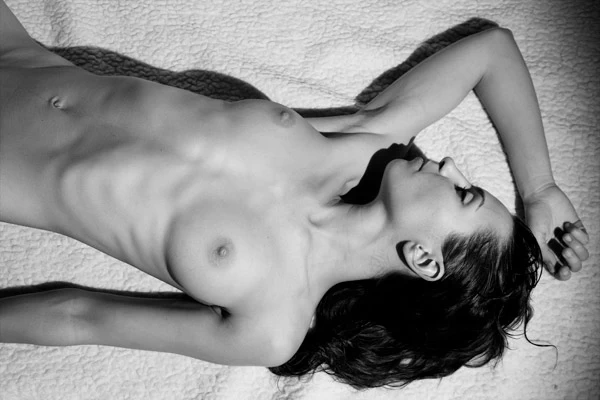
In the next picture you see the same photograph, edited in a much more contrasty way. Notice that it is not only the ribs and the abdomen area that are emphasized, but also the collarbones, tendons and muscles on the arms, shoulders, neck etc. The model’s face has also gained a different charm and the whole photograph has a much more dramatic effect.
Why do we photographers do it?
To speak for others would be unobjective and perhaps cowardly, so I’ll state my own reasons. As I mentioned, I like slim women. As a photographer I like very delicate models, I work well with them, because the camera can be merciless and add kilos where there are none. You might be surprised what can come out of a fifty-kilo model (which is roughly the average weight of my models) when you choose the wrong focal length, angle and light. In the same way I can take off kilos where there is an excess, I can change the size and shape of buttocks, waist, hips, legs and anything else. And perhaps from practice I’m so used to the imperfection of our bodies that I subtract or add automatically. Another reason is that I don’t want to keep photographing polished things over and over; I need some drama, expression, mood.
I don’t know, and at this hour I almost don’t care (it’s a quarter to three in the morning again) …
I know that „disgusting“ comments won’t disappear globally and I don’t even want that, but if at least one person in the world understands that a good photographer in collaboration with a good model becomes a storyteller of whatever he sets his mind to, this article has meaning and a right to life among us, thin or fat …
And if you agree with me and see ugly and insulting comments somewhere under a quality photograph, put a link to this page in a further comment. Perhaps somebody will wake up again and become more tolerant, and it will be a bit more cheerful for all of us.
Want to learn more? Visit the nude photography course.