This page was translated by AI. Please be forgiving of any mistakes.
‹ Photo Notes · 13 února, 2019
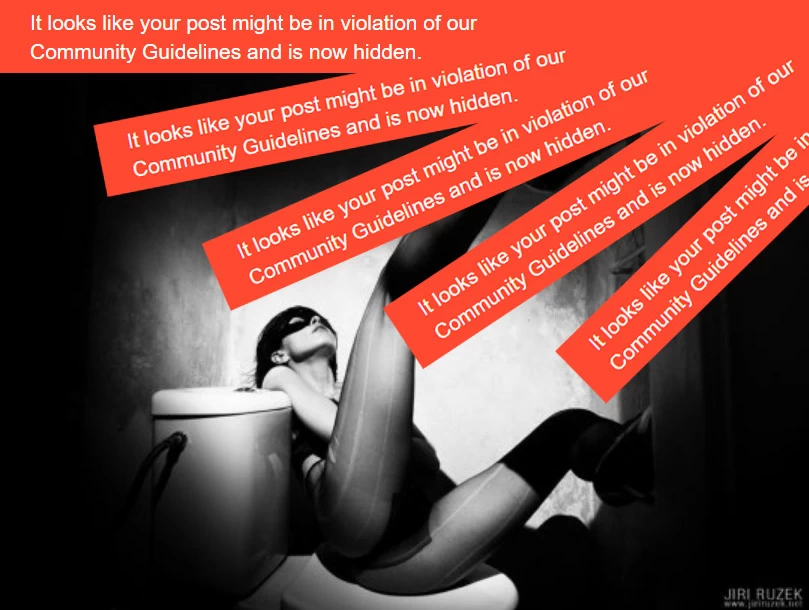
… or the twilight of censorship, and not only over the nipple.
I was still a boy when I heard that someone had been „locked up for beauty“. Some even twice. It was an ironic way of calling someone hideously ugly. But I don’t want to write about that; it just floated up from the depths of memory while I was looking for a title for today’s article.
This is about social networks and other places on the internet where we like to publish our photos or videos. That’s nothing new, you’ll say, everyone already knows that nipples and genitals are banned on Facebook, so what is there to write about… Unfortunately there is plenty to write about, because things are tightening on social networks….
I had planned to write this article and started writing it before my YouTube account was permanently deleted a few days ago (just to make clear that it isn’t written out of some momentary resentment). The first impulse to write it was the article The internet war on sex is here by Violet Blue, which appeared as early as last summer.
While we’re at it, from time to time I make a video. Sometimes it’s a teaser, sometimes a backstage documentary, and other times an outpouring of artistic ambitions.
I always make two versions: a censored one, which goes (or until recently went) to YouTube, Facebook and the like, and an uncensored version, which I primarily upload to my Vimeo channel.
So my YouTube videos were censored, yet my account was deleted with no option to appeal. Supposedly for repeated violations of community guidelines.
It didn’t surprise me much; Google Plus once deleted my photo of Charles Bridge with the justification that it showed „buttocks“.
The aforementioned Vimeo (so far) treats nudity and erotica like this:
„Vimeo does not allow videos that contain explicit depictions of nudity or sexual acts (in most cases), nor do we allow videos that appear to be primarily aimed at sexual stimulation. ….
Of course, Vimeo respects creative expression … … That is why we allow depictions of nudity and sexuality that serve a clear creative, artistic, aesthetic or narrative purpose. … artsy, not porny“
We also have the magical tick box „adult content“.
Almost the same approach to content is taken by Flickr. It even covered itself years ago and marked my whole profile as adult content, and that was that.
A surprise was Tumblr. For years it promised it would stay free forever, but in December 2018 it changed its rules and started mass-deleting content, see for example the opening photo of this article, which actually shows nothing at all.
Quite recently the community guidelines were also changed by Facebook and Instagram, which belongs to Facebook. Because their „nudity policies are gradually being refined“, you won’t get a clear answer on what you may publish and what you may not. Almost every prohibition comes with an exception such as „unless intended/aimed/shown…“, but once you realize that in practice these rules are enforced by an army of overworked admins in India who have about a minute to decide whether a picture is explicit or medical, educational, a protest and so on, it’s clear what kind of colossus we are dealing with…
You will also find absurdities like this in the rules: banned are „close-ups of fully nude buttocks unless digitally placed on a public figure“. Clear as mud, right? 🙂
I recommend reading the complete rules of Facebook on posting adult nudity and sexual activity.
But Facebook didn’t stop at imagery; its community standards now protect us from sexual harassment too, such as „do you want to have a good time tonight“. Yes, for a sentence like that Facebook can now punish you with a temporary or even permanent account block.
Also banned is „explicit talk about sexuality beyond merely naming or mentioning sexual arousal or intercourse“.
You can read what exactly Facebook considers sexual harassment here.
Content is filtered by Twitter too.
Patreon, popular for example with many models who post uncensored photos there for a fee, has also announced blocking of adult content.
Google filters search results markedly more than in the past. For our safety, of course. In practice it means that, for example, it sends 1,000 fewer people to my website every day (and that is a very modest estimate based on the traffic statistics).
With Google it’s not only about search, though. Gmail likes to mark messages from me as spam, and does so even in the middle of a conversation. Someone and I exchange messages, two of my replies get through, and the third lands straight in the spam folder.
Even Google Drive scans the content you store in the cloud, and it happens that a photo or video disappears or doesn’t show up when you want to send the file to someone (similar behaviour has been reported with other cloud services too).
Paypal, Payoneer and other online payment portals block payments that, in their view, are connected with „adult services“. This affects, for example, bloggers who write about sexuality or about artistic erotica.
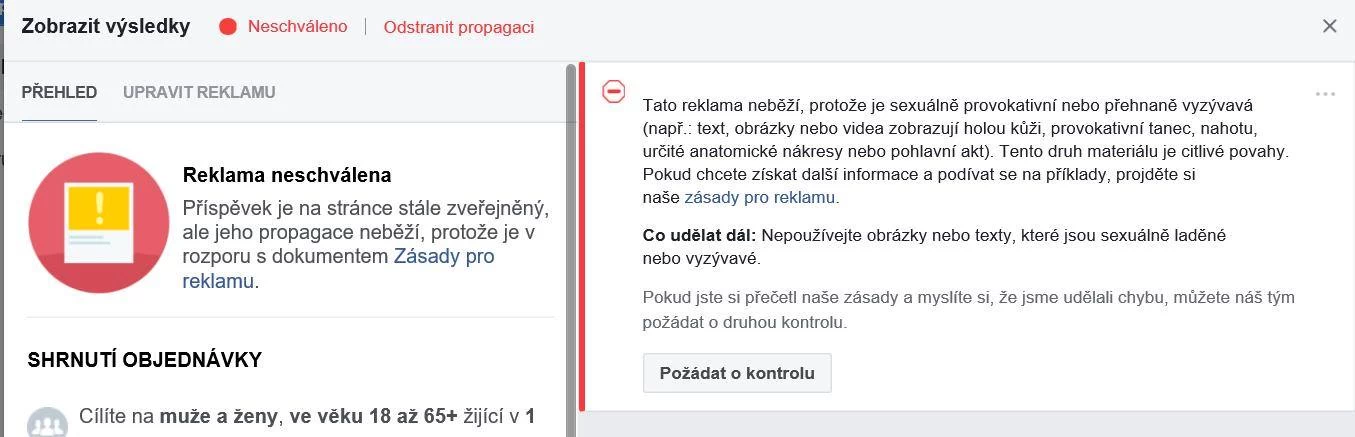
For example, I cannot pay for advertising on Google or Facebook at all, even though their robots keep pushing ads on me. As soon as I try, they let me know that I fall into a category similar to weapons and drugs.
It’s sad, but one could go on endlessly.
What is actually going on?
One thing needs to be realized. As long as the internet was fragmented, it was freer. Today the vast majority of popular internet services belong to a few giant American corporations. And whoever doesn’t belong there is mostly dependent on the big ones.
The case of Tumblr shows it nicely. It changed its rules immediately after Apple removed its app from the App Store. The new measure reportedly affected more than 12 million profiles in the very first wave. Google has a similar lever with its Google Play.
Even though Facebook and others claim they want to create a clean, nice and safe environment for us, in reality they are creating an impeccable environment for their advertisers.
FOSTA-SESTA is another buzzword and killer of the free internet. It is a package of laws (on censoring sexual content) passed by the US Congress at the beginning of 2018. The goal is laudable; in short, it is a fight against the online trade in sex, in people. But you can’t make an omelette without breaking eggs …. And the road to hell is often paved with good intentions.
The phenomenon called FOSTA-SESTA also caught the eye of a group of MPs in Great Britain, who immediately made it known that it would be nice to apply similar protection to British citizens too.
What (will) happen next?
I don’t know. We got by somehow before and we’ll get by somehow again. The point of the article was neither a how-to nor whining, just information about the current state.
If this topic interests you more, I recommend reading other articles by Violet Blue (the latest is called How sex censorship killed the internet we loved). This writer and blogger has been devoted to erotica, sexuality and the internet for many years, and as an expert on the subject she is often invited to various discussions (for example CNN or The Oprah Winfrey Show) and so on. Besides the fact that I like reading her articles, I like her also because some time ago she very nicely praised my photos 🙂
The internet and social networks are not only for fun, they are also powerful work tools. We got used to them, and with all these growing bans we don’t feel like kicking the habit. But in the meantime we have to learn to navigate around them skilfully, and we can only hope that at least here at home and across the whole old continent common sense will be preserved. In Europe, after all, erotica and erotic art have such a long and beautiful tradition.
And maybe the internet will change again, as it changed in its first phases. I don’t know how, but I know it’s possible. There are already plenty of alternative networks, and the fact that they are small today means nothing. A few years ago even Instagram was small. And Facebook? It started 15 years ago from zero as a service for the young. Now it has two billion users, but a lot of young people already prefer other social networks. The ones where their parents and grandparents are not.
We’ll see…. and no, hopefully they won’t lock us up for beauty 🙂
EDIT 2020 – …and now also on Patreon.
EDIT 2026 – time flies terribly fast. Who even remembers what Google Plus was? The article was up to date at the time it was written.