This page was translated by AI. Please be forgiving of any mistakes.
‹ Photo Notes · 1 května, 2014
This article is a reaction to Martin Kamín’s recent reflection comparing DSLRs with mirrorless cameras. It speaks to the issue in general, I to his arguments specifically, but I’m not out to provoke a „flame war„; like him, I’m just presenting my view of the matter.
The reasons why I sold my DSLR and switched to the Fujifilm X system I described in the January article. I summed up everything important to me in it and nothing changes about that even after half a year.
Martin is an experienced photographer with a great overview and, as he writes himself, about 15 different mirrorless cameras have passed through his hands in the last 12 months (the whole article here). And it is precisely in that passed through his hands that I see the problem. Only about 5 or 7 mirrorless cameras have passed through mine, but I have worked permanently with only one for half a year and can speak about it more knowledgeably. The others I held in my hands for a few minutes, hours or days, and that is little for any objective evaluation. In such a short time I not only can’t get used to a different way of operating, I have no chance at all of discovering all the advantages and shortcomings, sometimes hidden deep under the bonnet of first impressions.
After more than half a year with the Fujifilm X-E1 I therefore allow myself to sum up my impressions and findings. I’ll assess in detail only this camera, to the extent that I’ve had the chance to get to know and understand it so far. I’ll touch on some others only on the basis of what I’ve experienced or even just read; I won’t comment on others at all, because they don’t interest me and so I know nothing about them. Martin’s article will serve me as an outline from which I’ll deviate at any moment according to current need.
The main players
Right at the start, from my point of view, apples are mixed with pears. Comparing, for example, the Nikon 1 with the Sony A7R is like comparing a Trabant and a Mini (both are small cars). If I want to swap one system for another, I should consider only the same or a higher category, so of the main players only Fujifilm and Sony remain in the game for me, perhaps Pentax, but I lack information about it. And how could Leica fall off that list? Isn’t it because it isn’t discussed?
Ergonomics
How it holds and operates
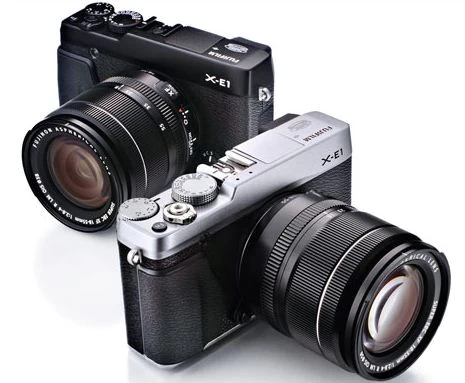 Here too I’ll start by saying that once we exclude low-end cameras like the Nikon 1, I see no fundamental problems. Size is clear; for anyone who buys a grip as the first accessory for every DSLR, all mirrorless cameras will be small. For me the size and weight of the Fuji is an advantage. Digital DSLRs, on the contrary, keep to the trend of bigger = better, but compare them with the size of the 35mm film cameras Zenit, Praktica and others, or rangefinders like the Leica, Bessa, Kiev, Hi-Matic – the last-named I have at home and it is smaller than the Fuji X-E1, yet it is a splendid camera. The size and weight of professional D-SLRs recalls to me rather the medium-format Pentacon-Six. In a studio fine, but why should I lug something like that around when I don’t have to?
I carry the Fuji with me all the time, which before really wasn’t possible. Just as a test – there is no reason to haul it all – I packed into a Domke F2 the X-E1, 8 lenses (3 Fujinons, 4 Russian – pure iron – with M42 thread and 1 CCTV) and various accessories (hoods, adapters, filters, charger etc.) and I got to 3.4 kg including the bag, which itself weighs 1.4 kg. The heaviest of it was the Fujinon 56/1.2 lens at some 400 grams. What’s more, the lenses are so small that they fit into the side pockets and the inner space of the bag remains free, so I can add, say, 2 litres of wine 🙂
Back to the size of lenses – the new ones from Fuji are bigger than the old M42s, but if we shot on Zenits with the smaller ones, where is the problem? Are we yearning for size again? Not me.
The controls of the Fuji are intuitive and closer to analogue than those of current DSLRs (aperture ring on the lenses, time dial, EV, on the X-T1 ISO too), quick menu choices, saving of various settings, programmable buttons etc.. And I’d have to be wearing oven mitts to have a problem with the size of the buttons.
I bought a thumb grip – a little gimmick, but a properly braced thumb adds huge stability and firmness of hold – and a concave soft-release button, allowing more sensitive operation of the shutter release. And above all it adds a red element to the black-and-silver camera 🙂
If I ever buy a grip with a cushion for the palm, it will be more on a whim, I don’t miss it. If I were, say, a newspaper photographer, I’d probably deal with the need for a grip for vertical shooting, but I’m not, I don’t have to … I didn’t use one on the D700 either.
How it feels to look into it
I already wrote in the previous article that when I first looked into the EVF (electronic viewfinder), it seemed awful to me. Within a few hours I was thrilled with it. The viewfinder is of good quality, covers 100 % of the image and shows the current exposure, so I don’t have to take a test shot; I see even before it whether I have too little or too much light.
Noise (and image quality)
In a walk. I’m sorry (actually I’m not, on the contrary), but here Fuji is the winner. And even today’s phased-out X-E1, which in second-hand shops costs around 10,000 and new about 20,000. A Nikon D4 for 130,000 is no better off. 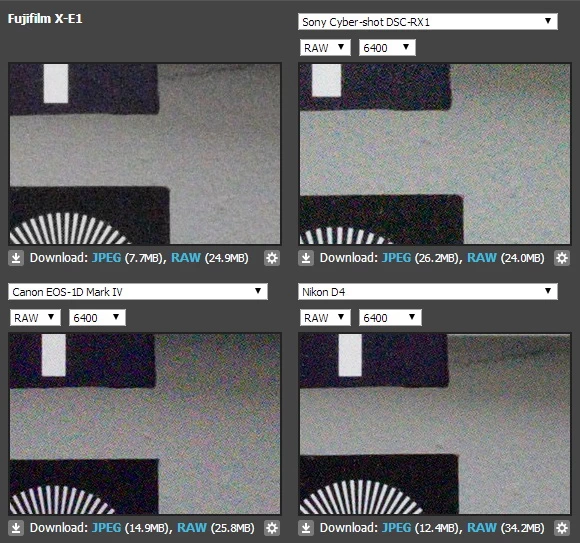
Click, pick any camera and the relevant ISO and compare.
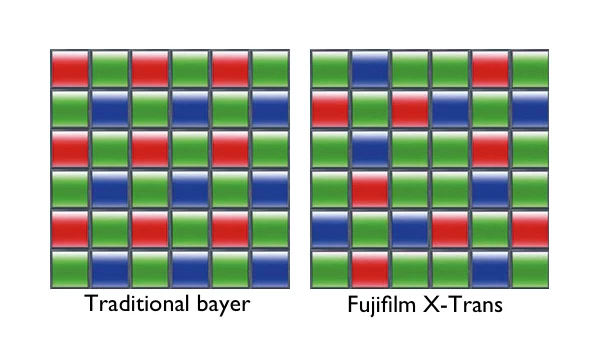
The trick of Fuji’s image quality is that it doesn’t use the so-called Bayer mask with a regularly repeating 2×2 RGBG pattern (a clear explanation by Roman Pihan, in Czech). Fuji instead uses its own filter with a 6×6 matrix in which the order of colours is arranged randomly. Thanks to that its X-Trans sensor isn’t as prone to moiré, and so it was possible to remove the anti-aliasing filter, which works on the basis of slight blurring – the result is a photograph with more detailed rendering and, thanks to the random distribution of colour elements, less noise too, which moreover doesn’t look as digital but in character comes closer to film grain. In the extensive review Fujifilm X-T1 versus Nikon Df Fuji reaches a value of 32 in the resolution chart against Nikon’s 28 and leads by 1 EV in dynamic range at higher ISO values.
On the image quality of Fujifilm it must be added that the image quality of the X100S, X-E1, X-E2, X-Pro1 and X-T1 cameras is identical with one exception, and that is the newest model, the X-T1, which pushed the quality limit for shooting at high ISO another step further – the quality of its photographs taken at ISO 12800 recalls the quality of ISO 6400 on the other mentioned instruments.

Fujifilm X-E1 + Fujinon XF 23mm/1.4
Lenses – quality fast glass is missing
I bought the Fujinon lenses XF 14mm/2.8, XF 23mm/1.4 and XF 56mm/1.2. Which of them is insufficiently fast and insufficiently good? I have no intention of buying the 35/1.4 or the newly announced 16/1.4.
The Fujinon lens range is merrily growing and the choice isn’t only Fujifilm lenses but also Zeiss or Samyang; through various adapters practically anything can be used. I bought several old M42 lenses with beautiful rendering at ridiculous prices. Because they’re manual, I don’t plan to use them for overly important shoots, more for pleasure. With the Nikon I had to sell all my manual lenses because I don’t have eyes like a falcon and I had way too many rejects. Fuji has so-called focus peaking, in which sharp parts of the image seem to light up, and thanks to that I can again afford to shoot with quality manual glass, of which there are around a thousand at prices from 300 to 3000 crowns.
Martin’s article mentions price too: „How many fast f/1.4 lenses for mirrorless cameras can you buy for under 10 thousand?„. Quality Fujinon lenses cost approximately from 15 to 28 thousand. That is not small money and Fuji really has no equivalent in its range of, say, a 50/1.8 for 3000 like Canon or Nikon. On the other hand these are lenses of the highest quality, and if we compare, say, the Fujinon XF 56/1.2 R for 28,000 and the Nikon 58/1.4G for 43,000, who is the winner? What’s more, all reviews of Fuji are full of superlatives and I can confirm myself that wide open (F1.2) it is beautifully sharp even in the corners, while in reviews of the Nikon I read things like „disappointment“ and „very soft„.
Yes, each of my Fujifilm lenses cost over 20,000, but let’s take into account that compared with Canon, Nikon and others I saved about 50,000 on the body. And the idea that for 10, 15, 20 thousand I can buy a second body is tempting too, and even if it lay around at home for half a year, it won’t hurt or force me to think, as when two D700 bodies lay here for us.
And all my Fuji lenses are as good or better (part of the quality is down to the X-Trans sensor, let’s not blame only the lenses) than anything I ever shot with on the Nikon.
And by the way – I have never met new 1.4 lenses for Nikon under 10,000.
Focusing
Focusing speed
Yes, here DSLRs have the upper hand. In the case of Fuji, though, it’s about the body, not the glass; I have all 3 Fuji lenses fast enough.
I also remember from the Nikon days wandering and eternally hunting lenses, e.g. various Sigmas.
Fuji isn’t slow; the difference is that DSLRs are „instant“. And in simplified and rounded terms, if one thing takes 0.1 seconds, it’s nothing. But when the second and third take just as long, we’re already at a third of a second, and that can mean a lost photo. Except that I don’t shoot such things and, if I’m not mistaken, you, Martin, photograph mostly landscapes and people, so I don’t know what you need that instantaneousness for in 90 % of cases.
I deliberately took the Fuji into different conditions, to an event teeming with people and action where it was necessary to aim and shoot. On top of that it was in the evening hours, already after dusk, only in street lighting. I often had to give up, the action ran away or somebody walked into my frame. But I say, it was in the dark, and with the Nikon too I’d have lost a lot of photos similarly; I noticed no drastic difference. And in the daytime the difference is completely imperceptible; the speed is splendid, though not the same.
Still, if I did press photography or, say, sports photography, I’d probably stick with a DSLR. Except that I don’t. On the other hand, look at what madness Jára Sijka shoots with the ancient and perhaps slowest X100 model (actually he shot, now he has moved to the X100S). Even the people at Fujifilm don’t understand it; the X100 is long since used-up oil for them (like my X-E1:)…
Ergonomics and focusing accuracy
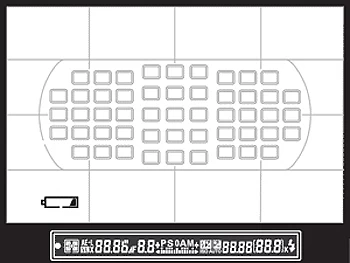 Where are the times when on the Nikon I chased 51 focus points around the centre of the photo and nothing at the edges (see picture). The current 49 on the Fuji are spread over the whole area up to the corners – splendid! On top of that I have 5 sizes of focus point available, so I can influence precision too (do you also know sharp ears instead of eyes?), and to change the size I don’t have to go into the menu, in fact I don’t have to take my eye from the viewfinder at all; it’s to hand, quick and simple.
Energy
Yes, battery life is (to put it very decently) crap for anyone used to the endurance of DSLRs. For the Nikon I charged 3 batteries once in a while and then took them whenever and went shooting; I didn’t bother about how much was left in each. On the Fuji I must. An original battery costs about 1500, a Chinese non-original 150 crowns. It’s no problem when I have 3. But I must have at least two on me for real; I never know when one will run out. There is room to catch up here. In winter it’s even worse thanks to the frost.
… enough
That’s all on Martin’s article. I think it’s important not to mix impressions with concepts, or impressions with experience. Everyone chooses according to needs and sympathies, me and Martin included. Once I chose Nikon instead of Canon like that – in terms of needs both instruments provided the same, but sympathy brought me to Nikon. Now I’ve again covered my needs, and with quality and comfort I went up, with price down.
In the second part of the article, more briefly (because I answered a number of things in the first part), I’ll describe my findings after half a year of working without a mirror. Again I’m talking only about the Fuji X-E1; newer models only passed through my hands, so I can’t assess them.
Do I have better photos thanks to Fuji?
No, equipment doesn’t make a good photo; it can only limit or support it, or sometimes even enable it. But I have higher-quality photos, and sometimes the Fuji really lets me photograph what I couldn’t before. The combination of splendid lenses and the X-Trans sensor is perfect and the difference in quality is truly visible.
Did Fuji spoil my photos?
Yes, I could easily say a lot of them. But I’d be lying; I spoiled them myself. At the very beginning I tended to succumb to the feeling that it shoots by itself, that quality at ISO 6400 is excellent, that the auto ISO function is comfortable and so on. All of it is true, and on holiday or on the street and anywhere else where I’m after photos for the internet or smaller prints, I can use these things everywhere. But for nude photography, where I expect the biggest possible enlargements at the best possible quality, I must have everything absolutely under control as before, i.e. I must shoot in manual mode as until now and keep ISO on a leash as far as possible. Simply not rely on miracles and set the best possible combination of parameters; otherwise everything is a matter of chance and then it’s too late to whine that I have nice times, but that the ISO could easily have been 1600 and didn’t have to be cranked to 6400.
Another problem was getting used to a different way of editing, but that’s another chapter.
Where do I see the advantages of a mirrorless camera, specifically Fuji?
- small size and weight of body and lenses
- price of body and price of lenses in relation to quality
- uncompromising lens quality
- fresh retro design
- focusing accuracy – points across the whole area and a choice of point size
- focus peaking for focusing with manual lenses
- image quality even at high ISO values
- quality of colour and contrast rendering, mainly outdoors
- dynamic range
- intuitive operation
- several nimble tools for working with dynamic range (e.g. separate highlight/shadow emphasis or suppression)
- super quality of JPG photos straight from the camera
(you wouldn’t believe how much time it saves – with the Nikon I shot everything to RAW, now I shoot nudes to JPG/RAW, the rest mostly just JPG, and I can mostly pass photos on without further intervention, which I didn’t know with the Nikon) - Fuji’s interest and support (not only firmware updates)
Where do I see weaknesses?
- battery life
- video – not bad, but it doesn’t stand up to the competition (certainly not the one from the X-E1; newer models are better off, but according to reviews there is still catching up to do here)
- speed of saving photos (if it wants to compete, it must speed up)
- short times are missing, at least 1/8000s (paradoxically the high speed of the lenses runs up against the shortest time of 1/4000s, often even at the lowest ISO; when you want to shoot at a low aperture number, there is too much light – the only solution is then an ND filter; I bought a variable one, a so-called fader)
I’ll certainly discover more advantages and disadvantages over time. I’ll share them, though probably no longer on such a scale. Perhaps I’ll sometimes do tests of individual lenses.
Choose as you like and what you like; if you’re considering a mirrorless camera, perhaps this information will be of some use to you.
Fujifilm cameras can be bought e.g. at Fujifoto.cz or Megapixel.cz.
You can view photographs e.g. in this year’s gallery.
Visit the next nude photography workshop