This page was translated by AI. Please be forgiving of any mistakes.
‹ Photo Notes · 28 července, 2015

Two weeks ago I asked Fujifilm to lend me the Fujinon XF 60mm/F2.4 R Macro lens for a test. I wanted to know whether it really is as terrible a lens as people say. Something didn’t add up for me, but without personal experience it’s hard to judge…
And precisely because most photographers don’t have that personal experience, I decided to test the sixty in practice, share my feelings and above all show some photographs.
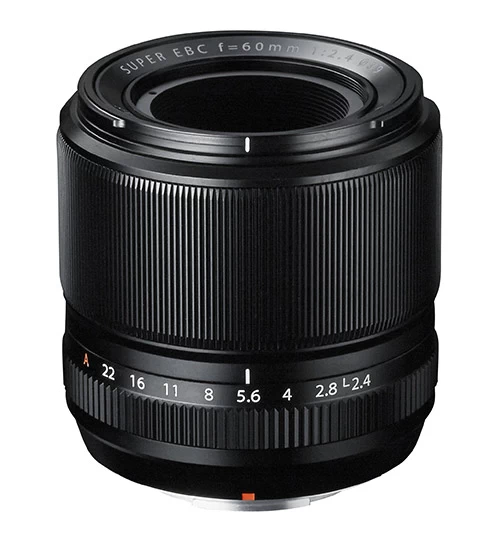
The history of the lens with the full name Fujifilm Fujinon XF 60mm/F2.4 R Macro begins in 2012. Together with the Fujinons XF 35mm/F1.4, 18mm/F2 and 18-55mm/F2.8-4 it is among the very first four lenses created for the then novelties Fujifilm X-Pro1 and the half-year younger X-E1.
It is among the most compact and cheapest X Fujinons, but above all it is perhaps the most overlooked Fujinon I know. I wanted to form my own opinion.
To say whether something is good or not, you need a comparison. You probably sense that I’ll compare with the Fujinon XF 56mm/F1.2 R, whose focal length differs by a mere 4 millimetres, but in everything else it is completely different. Or almost everything…
The Fujinon 56/1.2 is rightly spoken of as one of the best lenses of the whole X line. The sixty quite understandably remains deep in its shadow. For many photographers, however, the 56/1.2 remains an unattainable dream.
So what is the XF 60/F2.4 R Macro like compared with the XF 56/F1.2 R?
It’s small and light (plus)
That can be said of all Fujinons of the X line, but here it applies especially. I think that in making its first X-mount lenses Fujifilm strove for maximum compactness. 215 grams is almost half the weight of the XF 56/1.2, which weighs 405 g.
Does it feel cheap? (I don’t think so)
I come across the opinion that it gives the impression of a cheap plastic toy, but when I take both lenses in my hand, I hold the same quality combination of metal and glass; the difference is only in the weight, and perhaps that influences this feeling.
It is a fact that almost all newer Fujifilm lenses are heavier; even the XF 14/2.8 weighs 20 grams more.
It’s cheap (plus)
It costs about 10 thousand crowns less than the fifty-six, that’s almost half the price. The lower price is also typical of the first X Fujinons.
It’s a macro (plus)
The sixty is currently the only X Fujinon with a macro mode. The magnification is only 0.5x, but even that is the most of all current Fujinons (the others range roughly between 0.1x and 0.2x; specifically the XF 56/1.2 gives a magnification of 0.09x).
It isn’t very fast (minus)
A speed of F2.4 isn’t among the best and can’t be compared at all with F1.2 on the fifty-six, but it isn’t a tragic number either. Remember the popularity of 135mm lenses with the most common speed of F3.5.
It’s a hunter and wanderer (in bad light yes – minus)
Focusing speed is probably the most discussed property of this glass. My experience is that in good light conditions it focused normally. Maybe it wasn’t the fastest, but I had no feeling that anything took long to it and I felt no need to compare speed; it didn’t limit me. I shot with it outside until half past nine in the evening, when it was quickly getting dark, and then I had to stop. In the dusk the focusing speed changed drastically: it hunted and hunted, when it found something markedly contrasty it finally focused, but the frequent result in the viewfinder was only a blurred blob.
But to show what light conditions I mean, I must add the exposure values I’d have needed to take the photo: with the aperture fully open at F2.4 and ISO 6400, the times came out around 1/5 of a second, so nothing I could shoot handheld.
It shoots well (plus)
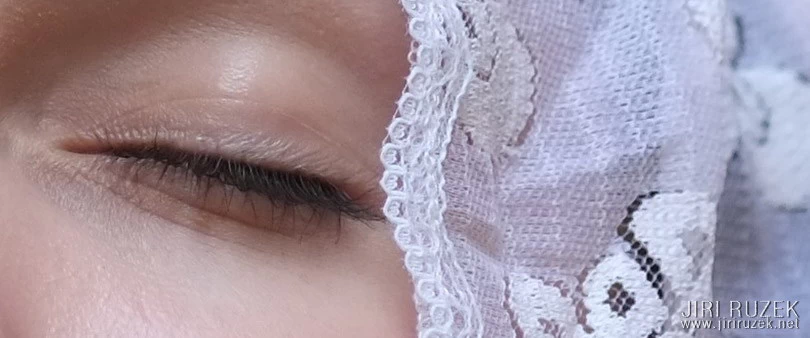
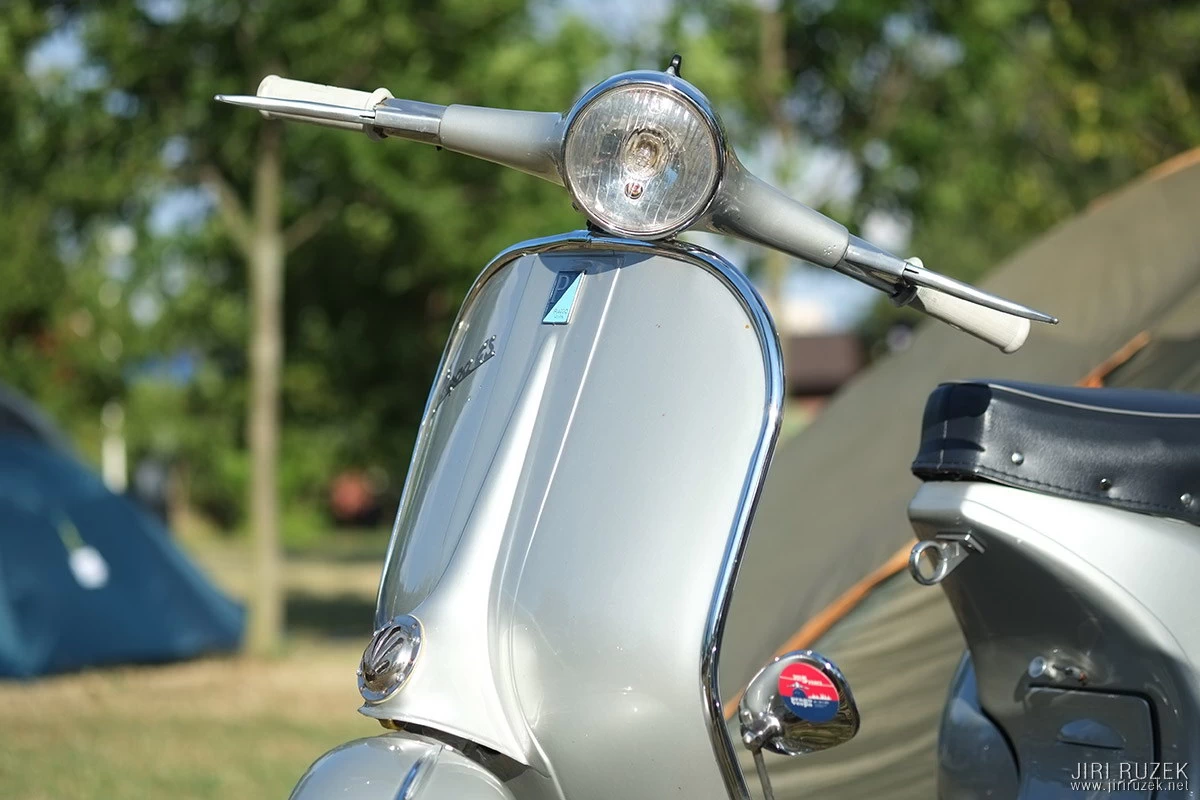
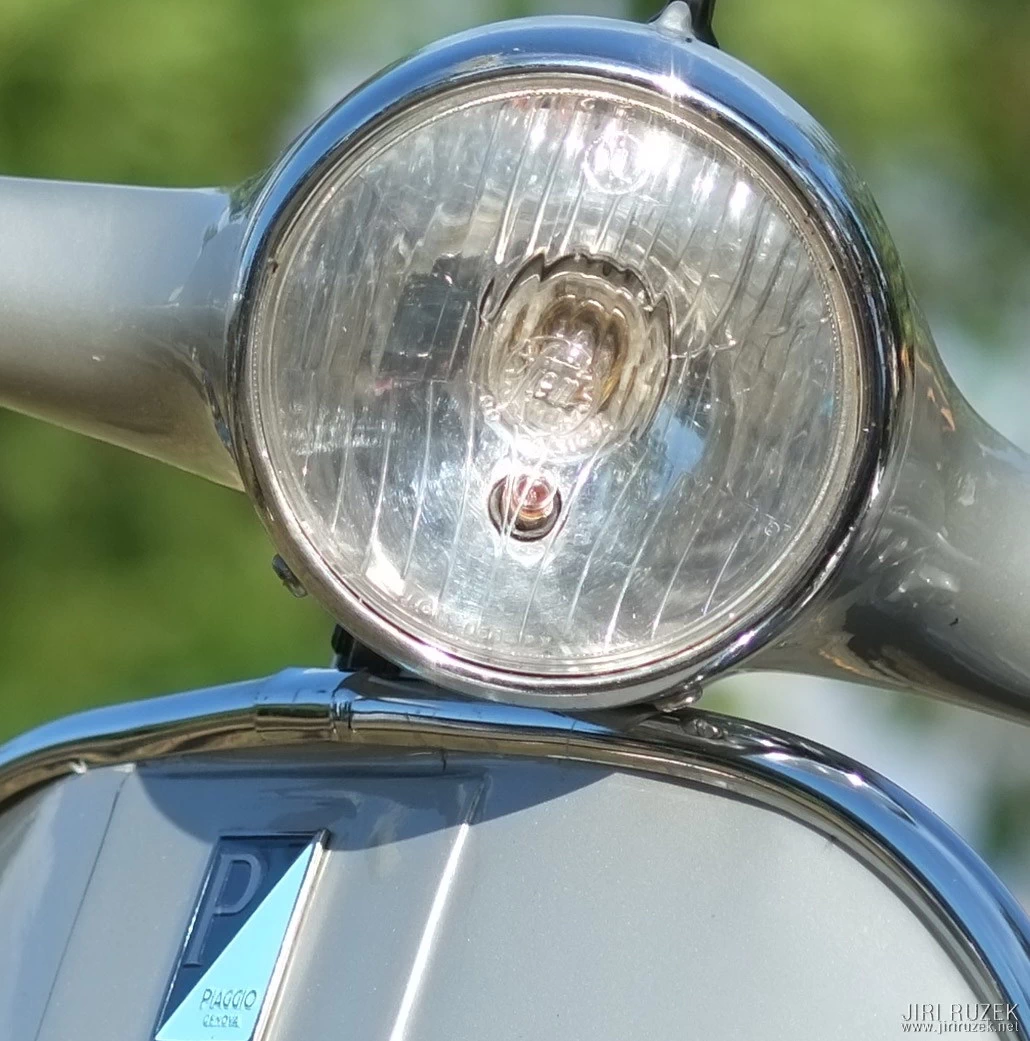
There’s no point elaborating on this one, look at the photos. Everything is shot „wide open“ and the photos are unedited, as they came out of the camera. Shot to JPG, portraits of the model Viki with the PRO Neg. Std. profile and the Vespa with the Provia/Standard profile. In-camera sharpening at value 0 (zero).

Summary
The Fujinon XF 60mm/F2.4 R Macro is definitely not a lens for bad light conditions. But photographers wish each other good light when greeting, and in good light the sixty behaves completely standardly. The rendering of the lens is sharp even at fully open aperture. Compared with the XF 56/F1.2 it has markedly lower speed, which by the way affects depth of field – with lower speed such a shallow depth can’t be achieved. But when photographing a portrait the aperture has to be stopped down anyway, otherwise in combination with this focal length the depth of field would be too shallow and, for example, one eye would be sharp and the other not, or even greater extremes where only part of the eye is sharp. The advantage of the fifty-six in this respect is mainly that even at a greater distance (e.g. a full-length shot – or a motorbike) very shallow depth of field can still be achieved; the sixty can no longer blur the background that much.
Would it be enough for me?
I bought the fifty-six at the very moment of its release, so a lens only 4 millimetres longer has no meaning for me, but if I didn’t have the 56/1.2 and didn’t want to invest that much money in it, the XF 60/2.4 would be a usable alternative portrait lens for me. The macro would be a bonus on top.
Honestly, I was expecting a disaster and was pleasantly surprised. Mainly by the quality of the photos, which is comparable with the other top Fujinons.
Off the record:
I originally wanted to write this article only after the holiday, but yesterday I received the Fujifoto bulletin and in it a mention of the ending Cashback promotion (ending already on 31 July). Cashback means Fujifilm returns almost three thousand crowns of the price to you. And because I wouldn’t like to hear that it’s a pity I didn’t write it two weeks sooner, I decided to change the order of my plans, and here are my conclusions.
At least you see this isn’t a paid article, otherwise I’d be better informed 🙂
Which reminds me (off the record 2) of a recent anecdote: a week ago I took the camera to a friend’s birthday party. Some man came up to me there and was terribly surprised that I really shoot with Fuji; he said he had read my articles but until now had considered them paid advertising and expected to meet me with a Nikon 🙂