This page was translated by AI. Please be forgiving of any mistakes.
‹ Photo Notes · 22 listopadu, 2014
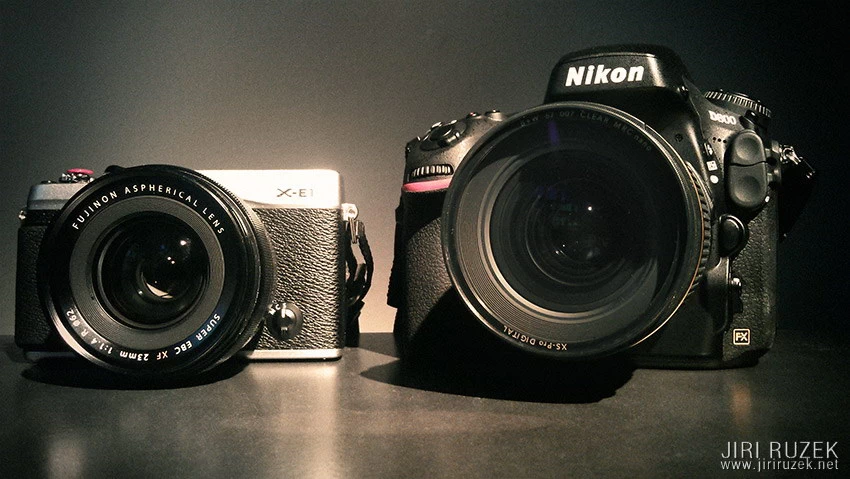
That’s really too much. Comparing one of the best cameras of all time, a Nikon D800 worth over 60,000, with a Fuji X-E1 for some 15,000? I completely agree.
So why did I take on something like that? No mystery. I had at home for a little over a week an acquaintance’s Nikon D800, to help him sell it along with a pile of lenses and other accessories. And since I had for a year had at home neither a Nikon nor any other DSLR, of course I wanted to get my hands on all of it again, and a certain comparison offered itself. Among other reasons because the Nikon D800 would most certainly have been my next step had I continued from the D700 further up the Nikon line.
What would await me? Again a full-frame sensor, a medium-format-like resolution of 36 megapixels instead of the current 12, quality video (instead of none). And again over 60,000 invested in the camera body. That is in short probably all.
That I chose a different path and went to the small mirrorless Fujifilm X-E1 is by now a rather worn-out matter. An investment (in the body) well below 20,000, 16 megapixels, it has video, usable, but not exactly this device’s pride. How could the two even be compared?
But it won’t leave you alone. That urge to play with it and maybe humbly admit that you might have been elsewhere. Or not?
Fuji is slow
The original intention was to concentrate mainly on comparing focusing speed. I know that DSLRs with quality lenses are faster, but there is a general myth that those Fujis hunt and hunt before they focus somewhere. That’s why I decided to run a comparison test, whose aim was not to prove somehow that the two cameras are equally fast, but finally to show in practice how big the difference actually is.
Testing anything else seemed almost pointless, because the D800 was drawn as the clear winner in nearly all points. Still I did a few more tests to see by how much it leads…
Enough talk, let’s go.
Dimensions and weight
FujiFilm X-E1: 129×74.9×38.3 mm, 350 grams
Nikon D800: 146x123x81.5 mm, 1000 grams
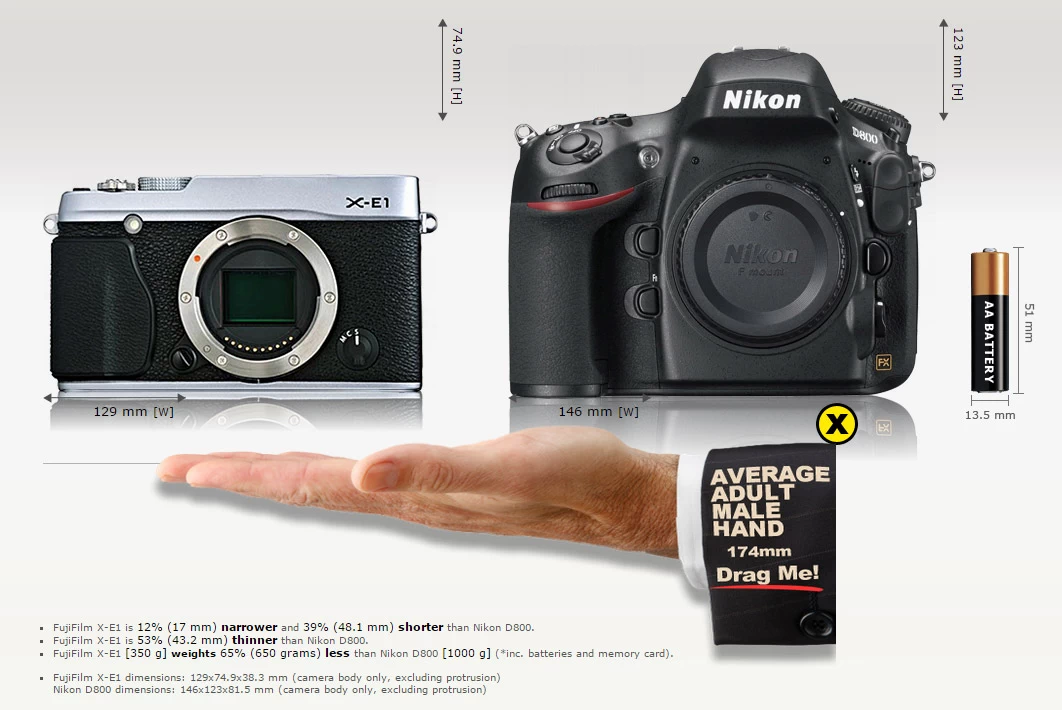
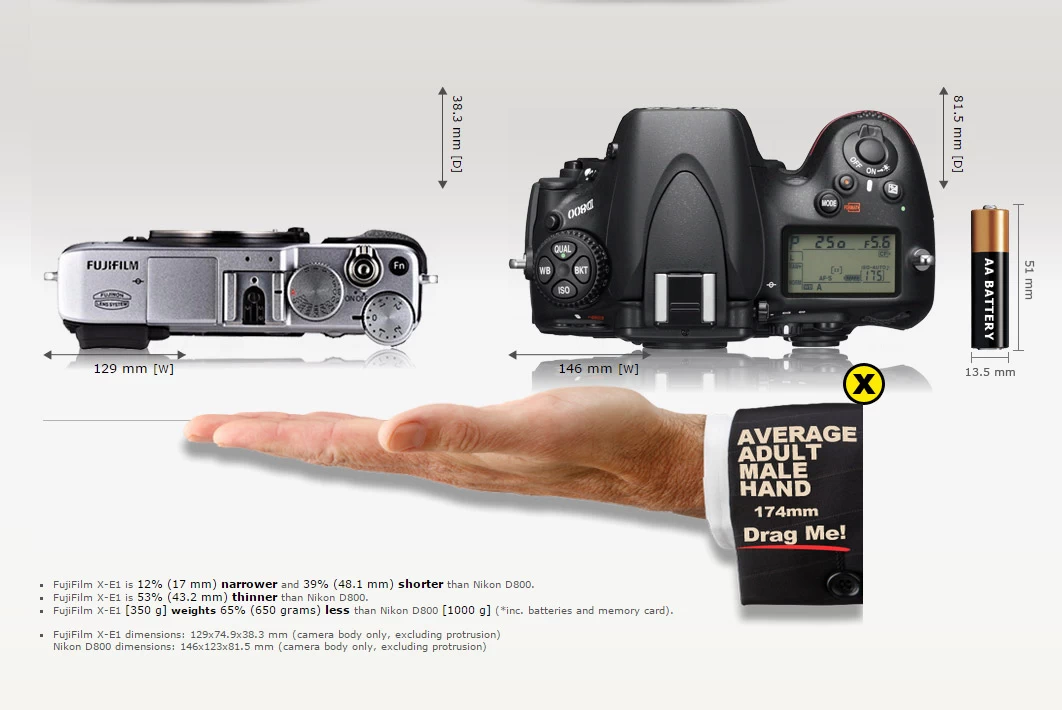
The Fujifilm X-E1 is 12% (17 mm) narrower, 39% (48.1 mm) shorter, 53% (43.2 mm) lower and has a 65% (650 g) lower weight than the Nikon D800.
This information is nicely presented on the website CameraSize.com – recommended.
A point for Fuji – in this case it was clear and easy, let’s move on.
Price
I state the lowest prices I found (November 2014); average prices are about 2 – 3 thousand higher.
Fujifilm X-E1 – 13,600 CZK
Nikon D800 – 59,000 CZK
Current prices according to Heureka.cz
A second point for Fuji, but again a well-known fact.
Sensor
Full frame – the cornerstone and holy grail of photographers. A year ago I myself claimed it can’t be done without it, and even now I don’t claim there’s anything wrong with it, even though I don’t miss it. In the past it wasn’t only about smaller depth of field but also about a completely different image quality. Times are changing…
The Nikon D800 of course has a full-frame sensor; the Fujifilm X-E1, like (so far) all X Fujis, is fitted with the smaller APS-C. Today’s article is not about the advantages and disadvantages of full frame versus APS-C.
A point for Nikon.
Resolution
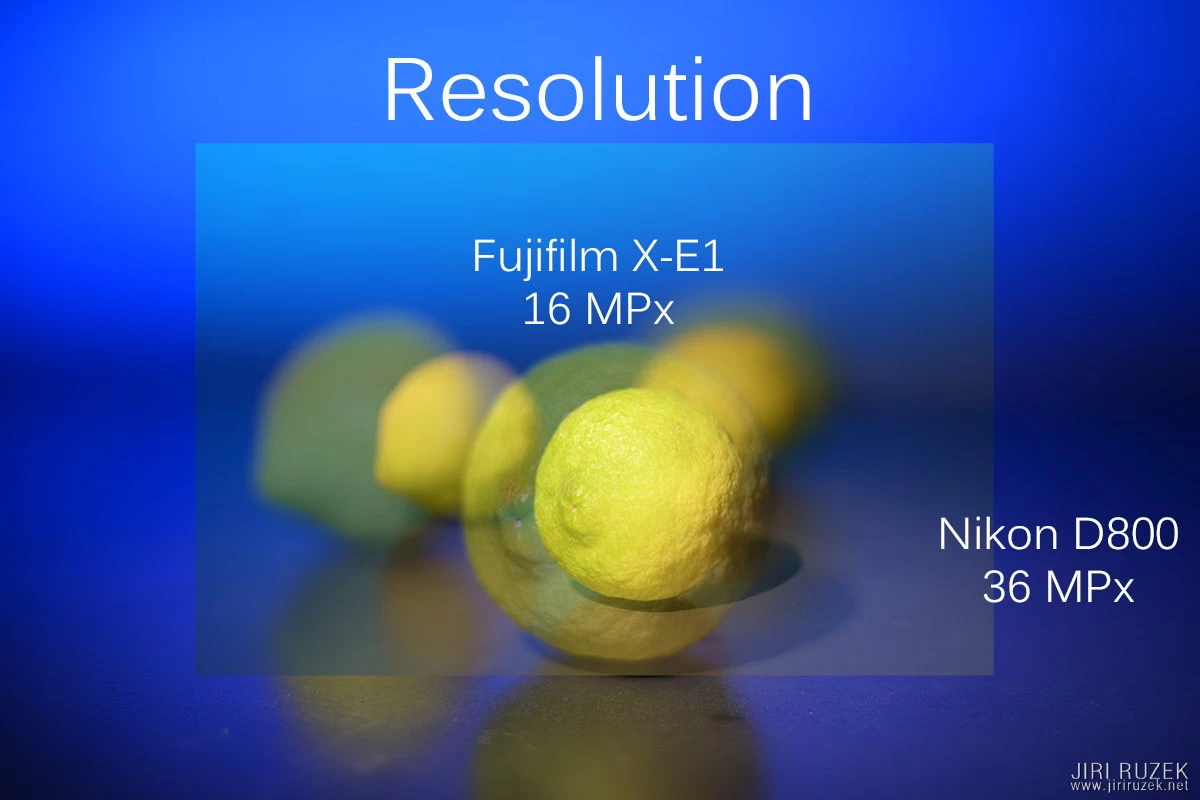
Nikon D800 – 36 megapixels
Fujifilm X-E1 – 16 megapixels


At first sight a clear victory for Nikon. The image from the D800 is 2.25 times larger than from the X-E1. That is, however, also a frequent subject of polemics; for some, for example, such resolution is off-putting. What is it for? Supporters answer that, for example, it allows making big enlargements or gives more freedom when cropping – yes, two photos from the X-E1 fit on the area of a D800 photo with 4 megapixels to spare. Opponents claim (and I agree with them) that big enlargements can be made from far lower resolution too.

Another argument against is data size. The average jpg file from the D800 is about 12 – 14 MB, raw around 40 MB. Jpgs from the X-E1 are mostly under 5 MB and raw around 15 MB. This difference is of course noticeable in file copying time, space consumption on cards and disks, demands on memory and computer performance etc.
And another, perhaps the most serious, argument against is that electronics have outrun optics and that current lenses are not capable of feeding such resolution properly. It is said that they handle resolution well up to roughly 25 megapixels.
But let’s leave these polemics aside for now and admit…
A second point for Nikon.
Just for the record: the score at this moment is 2:2.
Image quality
I have to split this part in two, you’ll understand. In the first part I’ll deal with photographs in good light conditions, so that I can make maximum use of the potential of both cameras.
I shot the same scenes with the same or as similar as possible settings and tried to use similar lenses on both cameras. When I had the 28 mm/F1.8 on the Nikon, I chose the 23 mm/F1.4 for Fuji (equivalent 35 mm, I had nothing closer); against the Nikon 50 mm/F1.4 I put the Fujifilm 35 mm/F1.4 (equivalent 52.5 mm), in one case the 56 mm/F1.2 (equivalent 85 mm).
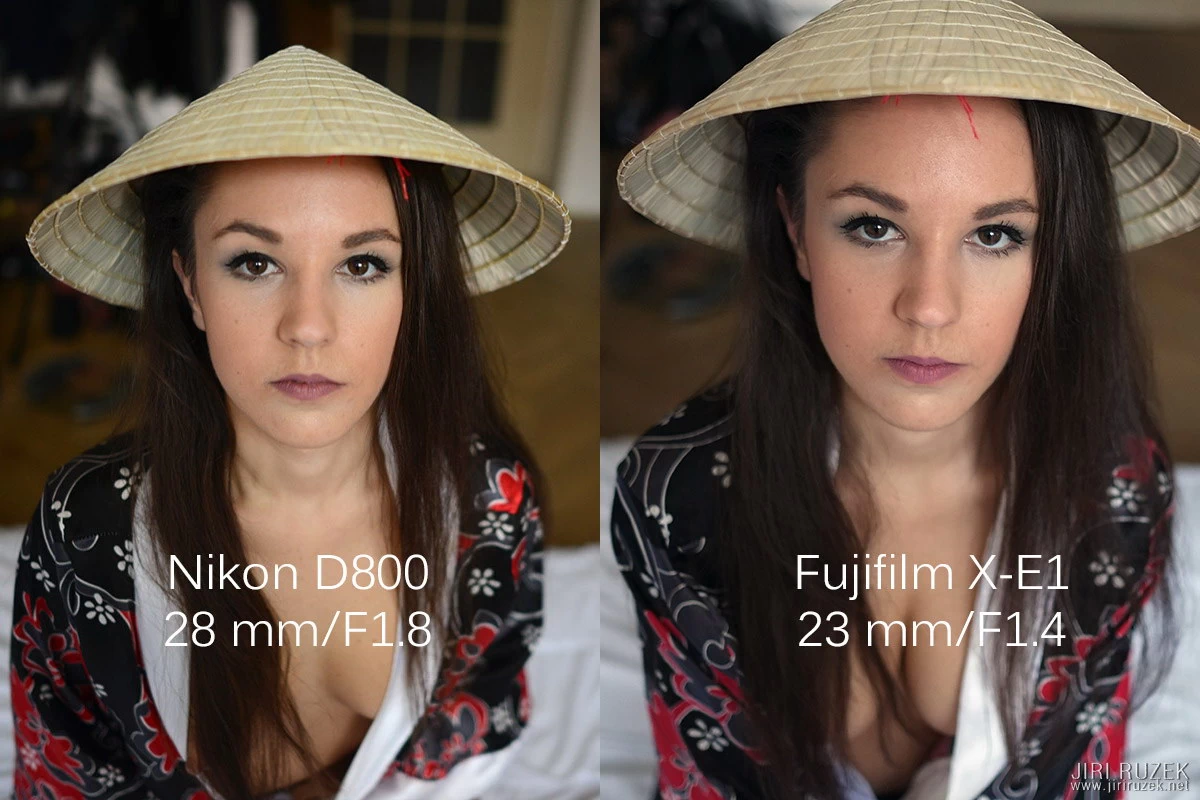
First I shot the model „wide open“, i.e. with the aperture fully open. Both unedited (and unsharpened) photographs provide almost identical quality and both seem beautifully sharp (I always focus on the eye).
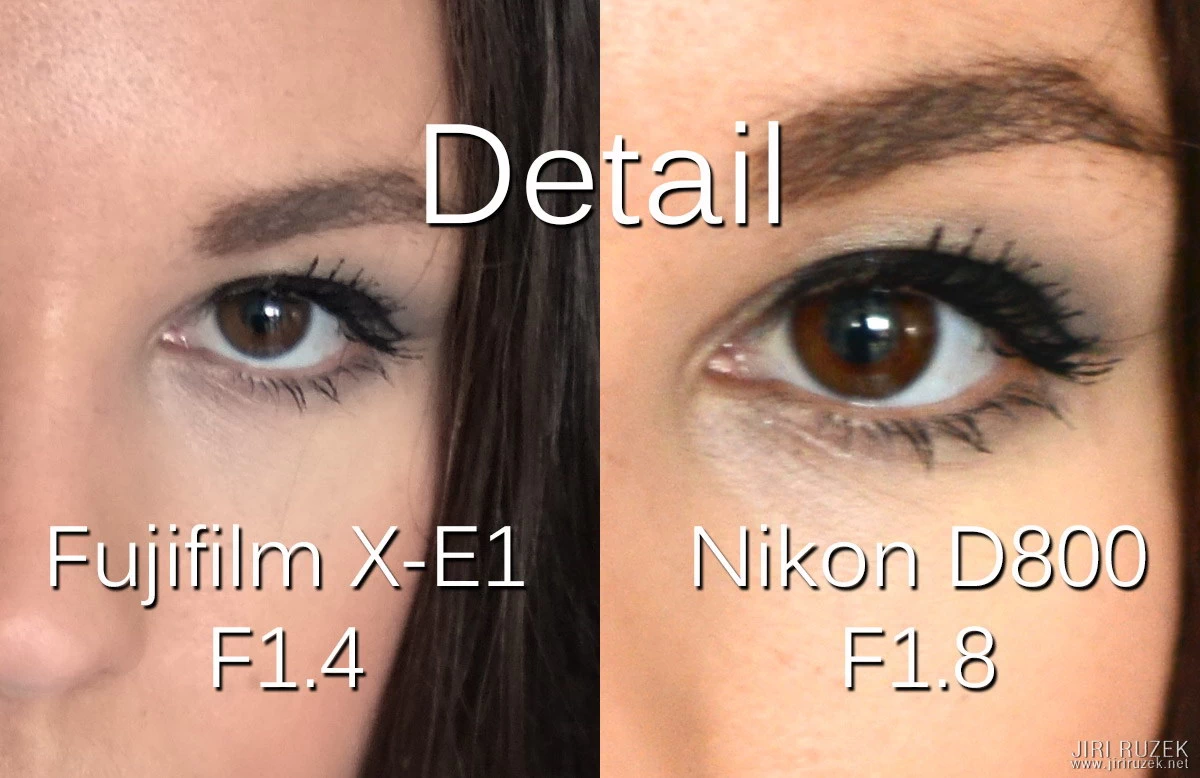
After enlarging to 100%, however, the photographs from the D800 are markedly worse. My first impression was that they were blurred (they weren’t) or that I’d focused elsewhere (I hadn’t). It also occurred to me that the lens really doesn’t keep up in quality with the huge resolution of the sensor. The truth is simpler: wide open, the rendering of the 28/1.8 lens is dreadfully soft.
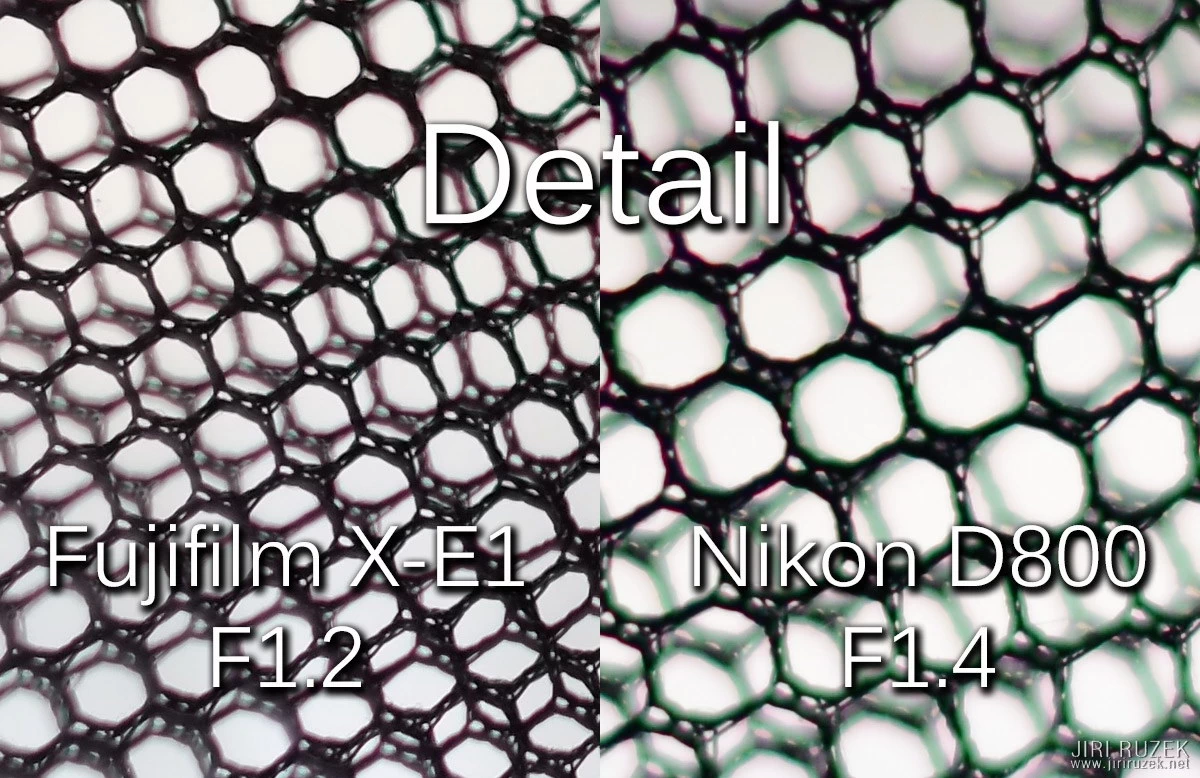
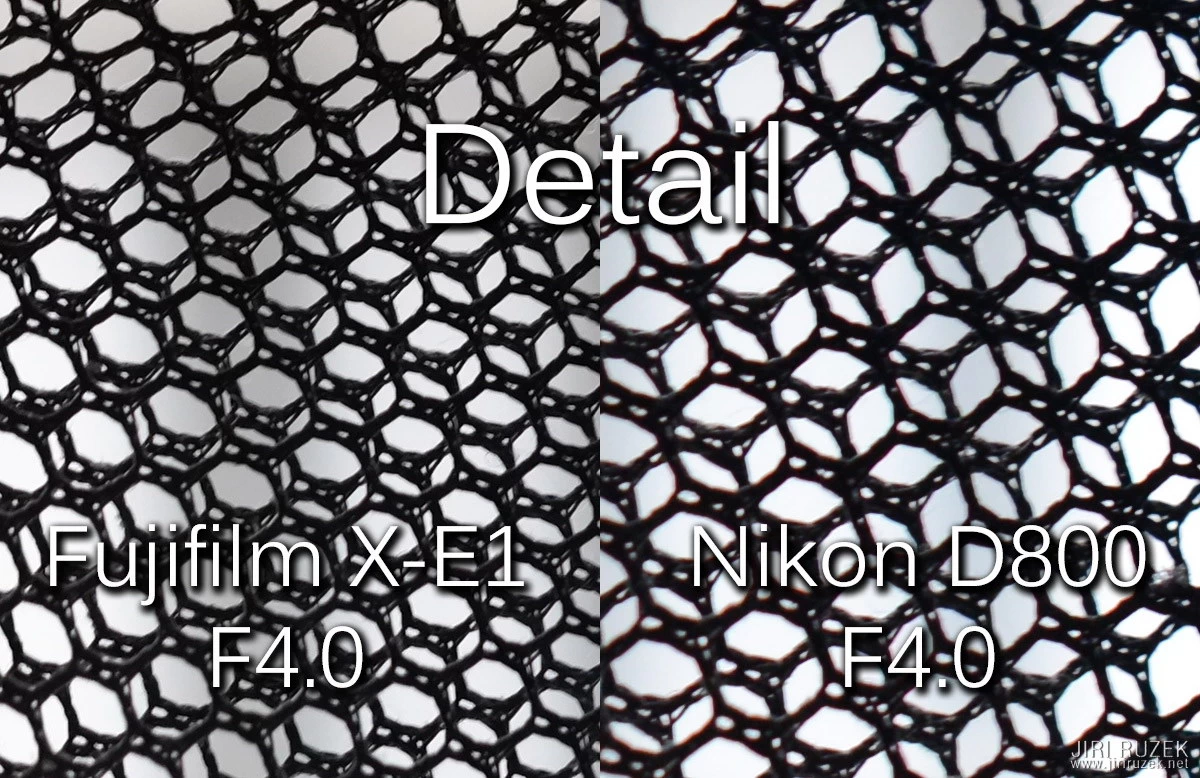
For further experiments I used the legendary Nikon 50/1.4 and on Fuji the 35/1.4 and 56/1.2. When shooting with the aperture fully open, the results from the 50/1.4 are much better (sharper) than from the 28/1.8, but I still find the Fuji lenses sharper, and moreover I observe a greater tendency to chromatic aberration with the Nikon.
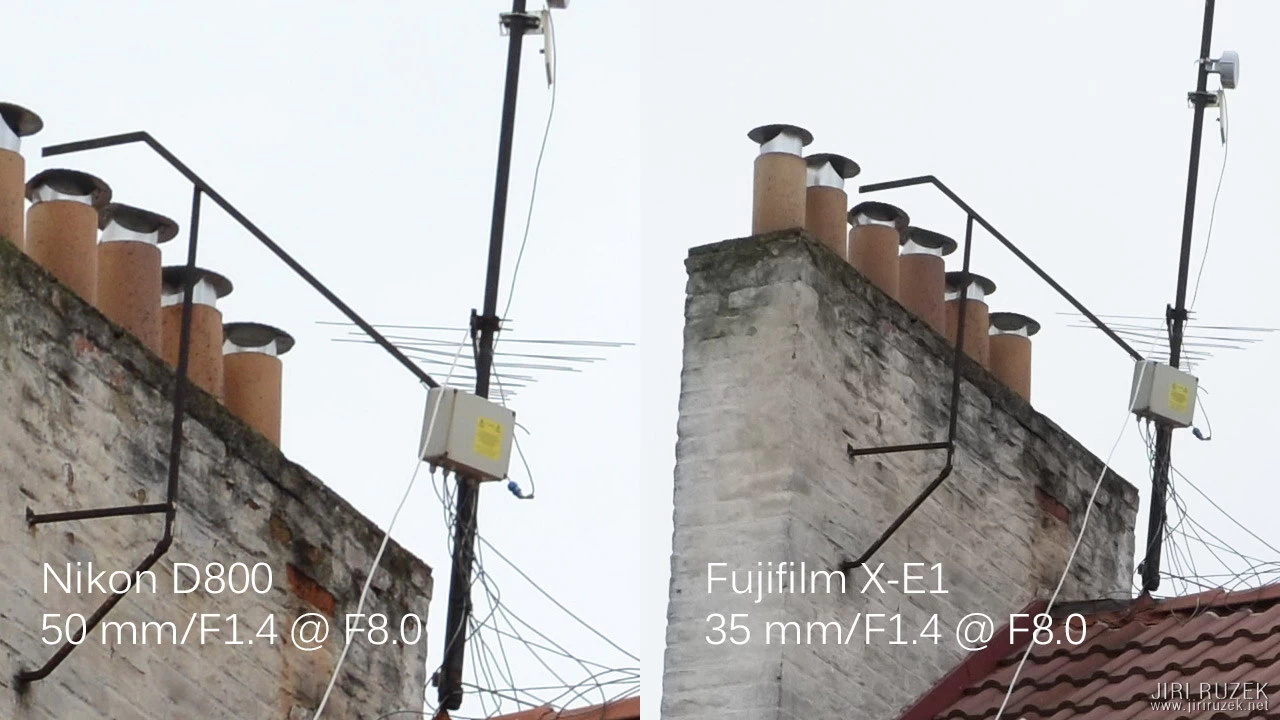
After stopping the aperture down to F4.0 there was a marked improvement (levelling out?) and at aperture F8.0 every hair is already sharp. And at a resolution of 36 megapixels. So I don’t have the feeling that this high resolution can’t be decently „fed“ optically. Wide open, though, it was a disappointment.
Note: I was told that the 50/1.4 lens isn’t recommended for the D800, but the 58/1.4 – the results here of course concern only the two lenses mentioned above.
A point for Fuji – resolution or no resolution, Fuji XF glass renders beautifully from the maximum open aperture.
High ISO and noise
Both devices boast extraordinary image quality in poor light conditions, when a higher sensitivity (ISO) has to be set. When you shoot film, you can really buy a film with a higher ISO value, i.e. more sensitive to light. With digital cameras it’s a bit different. There is no film and the sensor usually has a fixed sensitivity, corresponding roughly to ISO 200. The sensitivity of the sensor doesn’t change even if you select a higher value. It simply can’t. It still captures at the same value, but the image is then amplified to correspond to the sensitivity value you set. But enough theory…
I didn’t shoot step by step through ISO values; I made just a shot at ISO 200 (it’s in the video) and took a second photograph at the critical sensitivity value of ISO 6400. I remind you in advance that neither photograph has had its noise removed in any way; this is how I got them from the cameras.
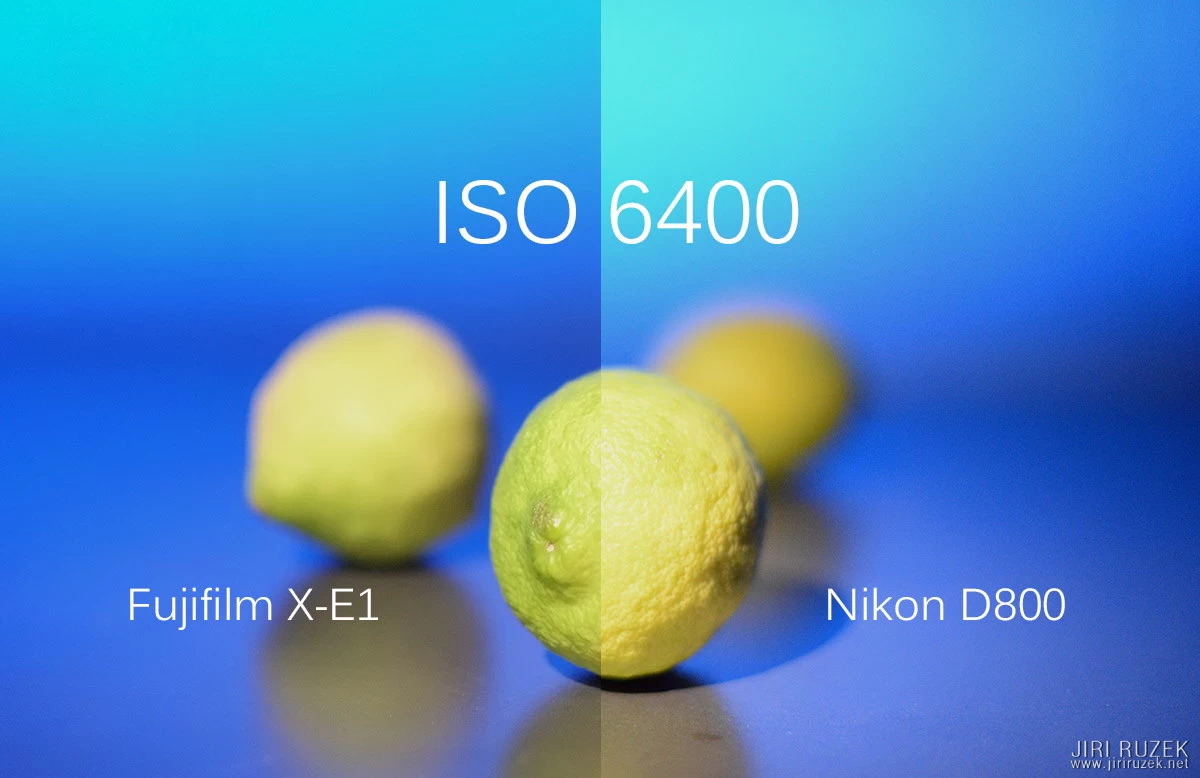
Photographs reduced for the internet are beautiful and at smaller sizes could be printed without problem. By smaller size I don’t mean 13×9, but markedly larger prints. I just wouldn’t want to make big enlargements from them – although even that could be done with some street or documentary subject matter, in my genre I’d rather not.
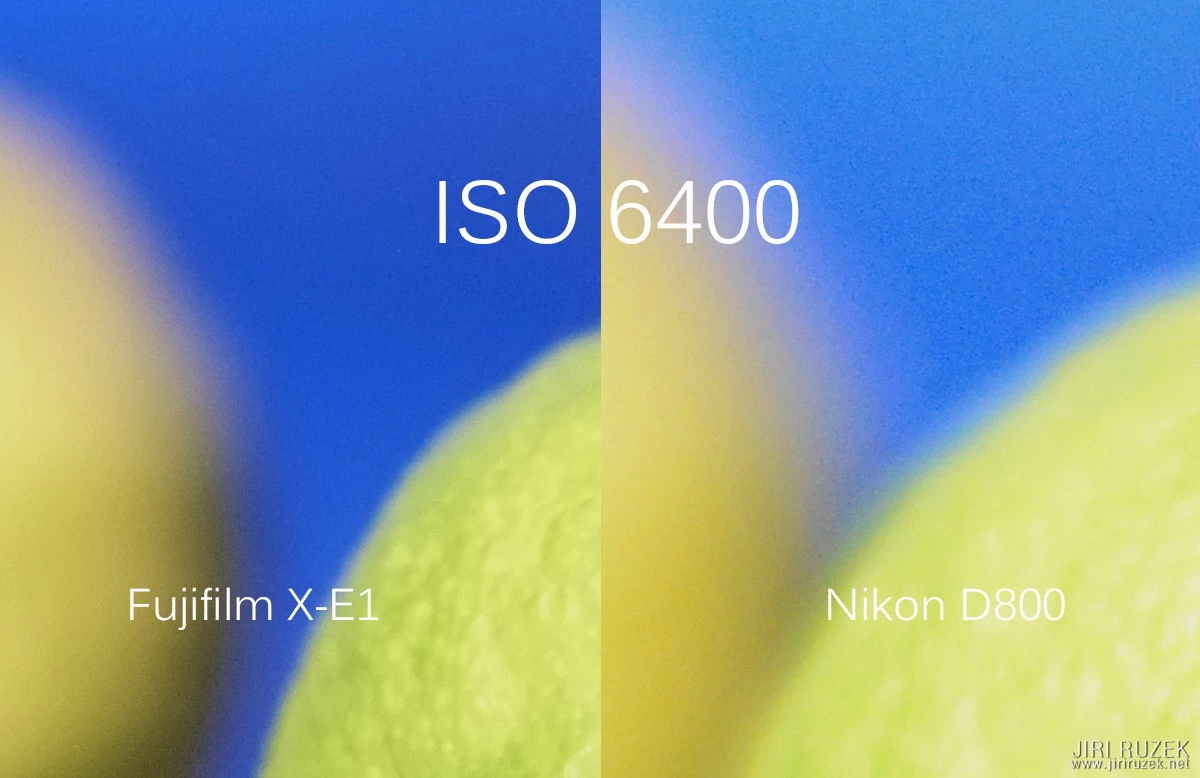
On to the enlargements. And here came a shock. My poor X-E1 beat the D800 completely uncompromisingly. But here we have another well-known polemic…
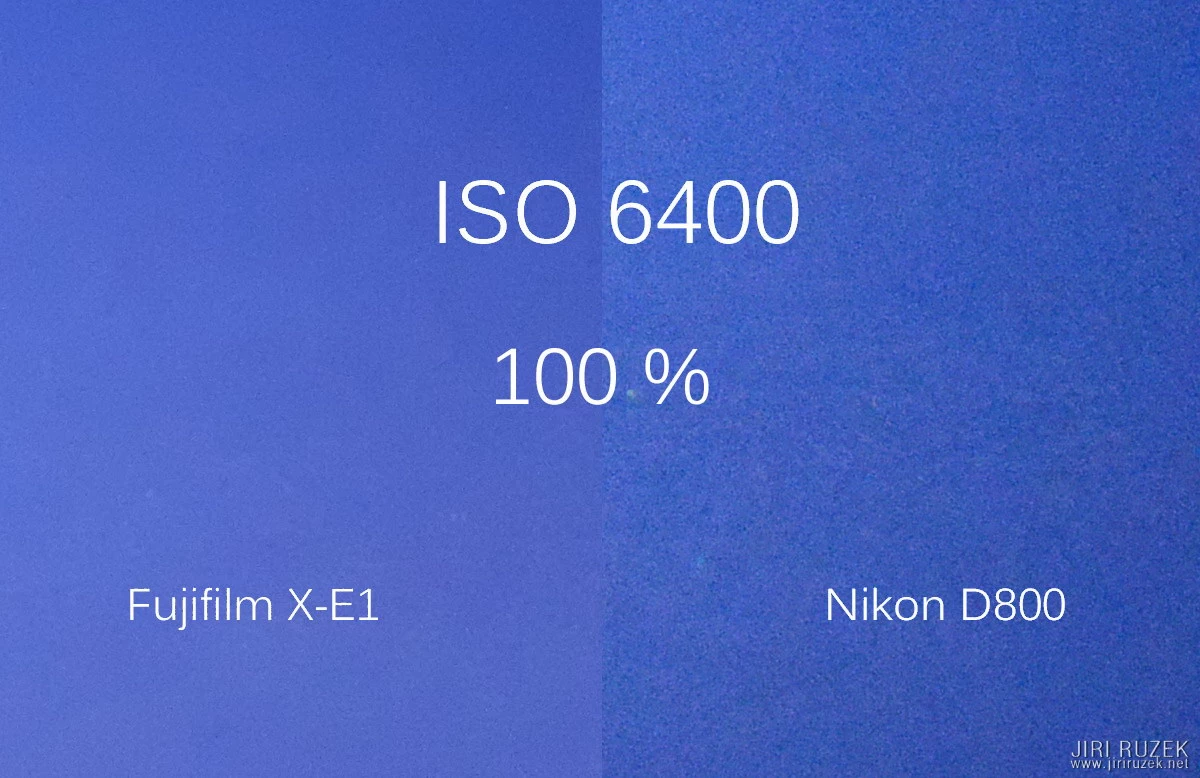
That „bit“ of extra noise gets lost thanks to the huge resolution. Translated, this means that if you want to print the same size photo from both cameras, you may have to reduce the one from the D800 (the noise shrinks too) and enlarge the one from the X-E1 (and enlarge its noise too).
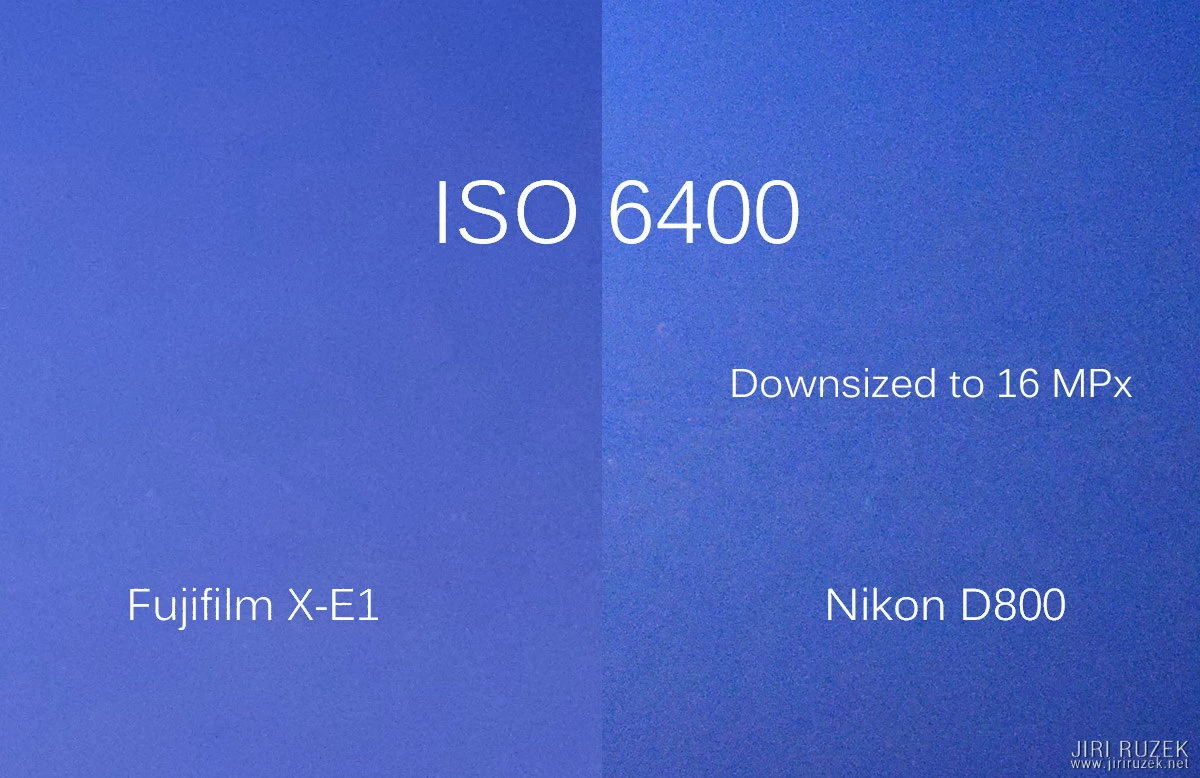
I did it – I reduced the photo from the D800 to 16 MPx. Fuji still leads.
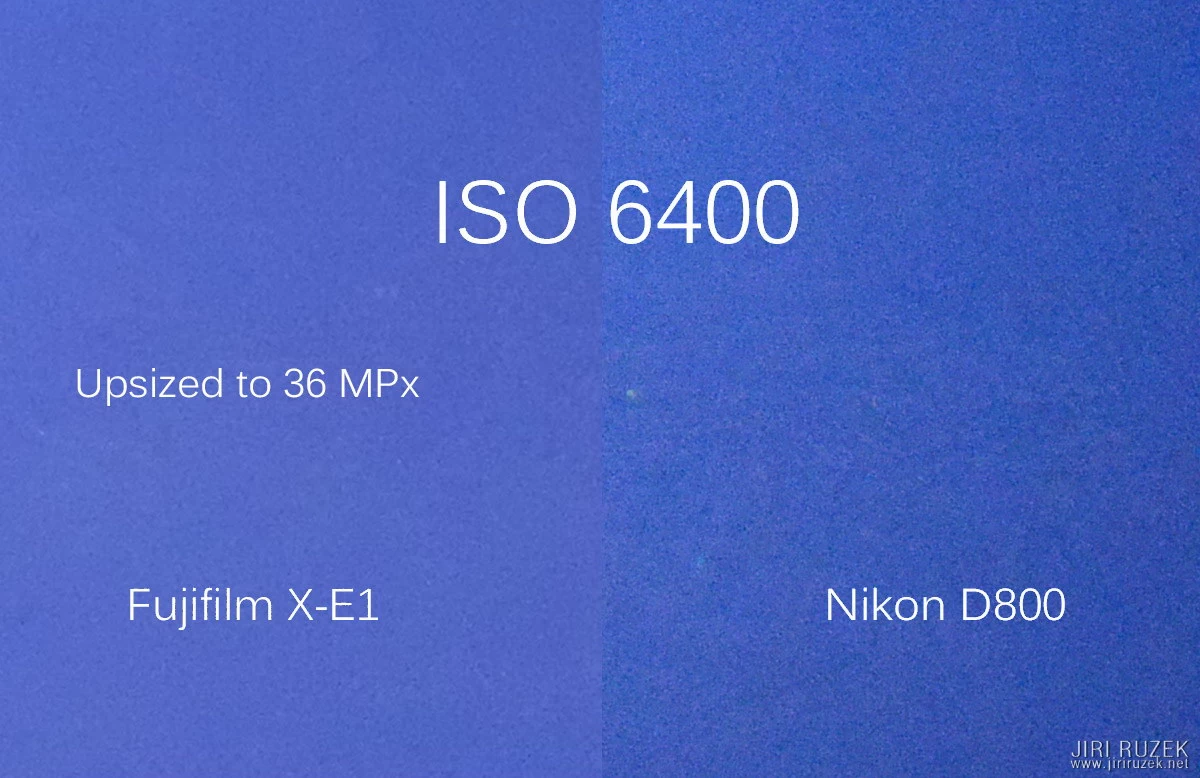
I enlarged the photo from the X-E1 to 36 MPx. It still leads. The image quality of Fuji is unreal.
(note: from several sides I received criticism of various kinds on the result of this test, so compare the noise at various ISO values in raw and jpg yourself at DPreview)
A point for Fuji (no question). The score is 4:2 for Fuji.
Viewfinder
Already the Nikon D700 had a window instead of a viewfinder, and the D800 isn’t behind in this respect. A beautiful window that delivers the image via a mirror (hence the name mirror camera).
The Fuji X-E1 has an electronic viewfinder. So now, without further explanation, I should give the point automatically to Nikon. But I can’t do that, because although I enjoyed the image from the D800, I terribly missed my electronic one, so used to it have I become over the year.
Not because it would offer some better image experience, but for a completely simple and practical thing, namely checking the exposure before the shot.
Yes, with a DSLR the procedure is this: I estimate the setting, shoot, check on the display, find it’s wrong (too much or too little light), readjust, shoot again, check again and probably readjust once more and shoot again. I have to check further photos too, because the light conditions may change. I know, I shoot manual, so I can blame only myself. But thanks to manual exposure I have a minimum of badly exposed shots.
On the X-E1 I look into the viewfinder, see a lot or little light, turn the aperture ring or the shutter speed dial, shoot and I’m done. At the first attempt. It’s a fantastic saving of time.
For the viewfinder I therefore give a point to both; the score so far is 5:3 for Fuji.
Focus points
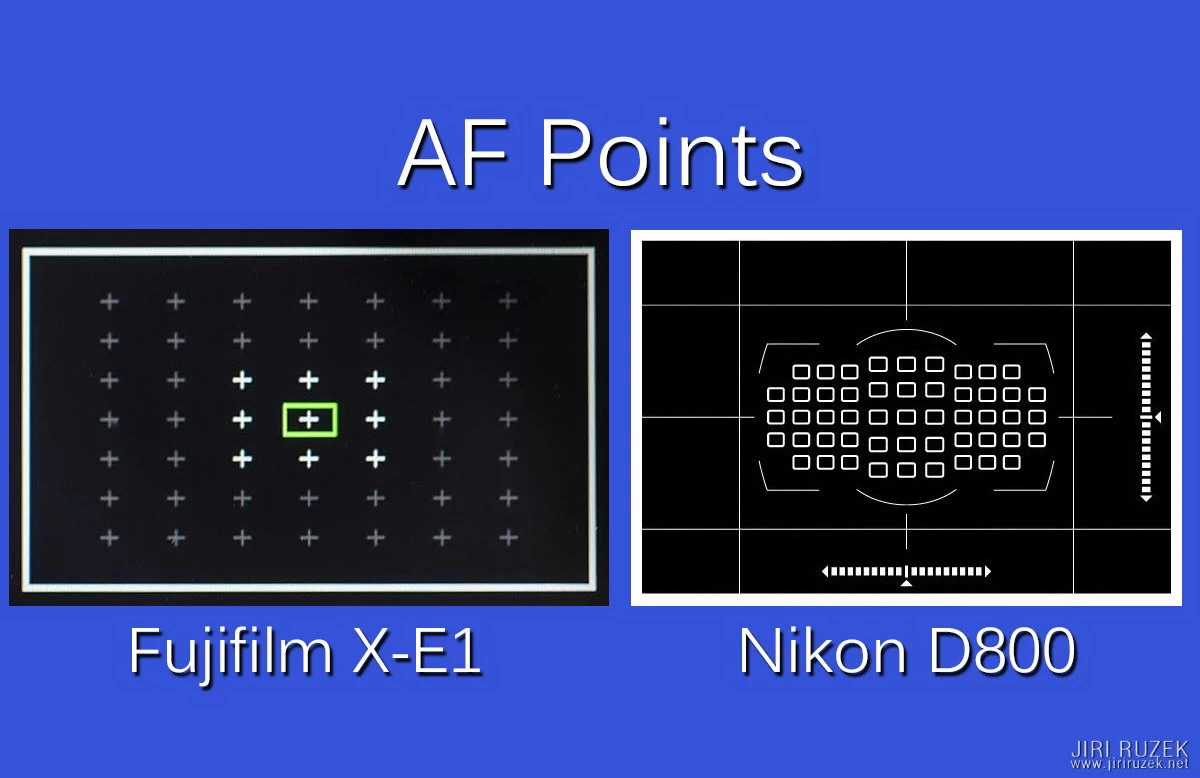
The technology doesn’t allow DSLRs to have focus points across the whole frame, so they are concentrated only around the centre. Fuji has focus points over the whole area of the image, no need to explain the advantage. On top of that, Fuji lets you set the size (precision) of the focus point in 5 steps.
A point for Fuji – 6:3
Focusing and shooting speed
No beating about the bush, I already wrote it at the start, I admit that Nikon of course won. How big or small the difference was, you’ll see in the video. The D800 isn’t fast, it is instant. It practically knows no delay. The X-E1 didn’t wander or hunt anywhere either, but the difference was there. I did an experiment focusing on five different points – Nikon won by a small margin. A markedly bigger difference came when I held down the shutter release and shot those five focused places. Nikon managed it in practically the same time; with Fuji there was a delay between focusing and shooting. Watch the video…
A clear point for Nikon – the score is 6:4
Fuji leads, but I give Nikon a consolation point for excellent video, which I didn’t test, and another point for the great battery, or rather its endurance.
Final score – 6:6
I’d gladly give Fuji a point for the shutter speed dial and aperture ring, but this match is friendly, so I won’t push. Besides, it would be easy to add a few points to both sides for this or that. The Nikon D800 remains even after this test one of the best cameras we’ve ever had at our disposal. Great respect. I’m not drawing a conclusion, draw it yourself.
The Nikon D810 (successor of the D800) can be bought e.g. at FotoŠkoda, Fujifilm cameras there too or at Fujifoto.
… but that aperture ring, that’s something so fantastic… like in the old days when a dog was spinning on the record player. Oh yes!
Below the line, both photos above quickly edited „my way“ … and uncensored 🙂