This page was translated by AI. Please be forgiving of any mistakes.
‹ Photo Notes · 16 února, 2015
I came across a discussion under some guaranteed guide to being a better photographer. One of the points was „always shoot everything in RAW“, and it was precisely this point that took the most criticism and contradictory opinions…
Lately I catch myself being more interested in the discussion under an article (regardless of topic) than in the article itself. Articles, mine included, are always just one view of a matter, whereas the discussion shows the opinions, experience and attitudes of others.
On one side was the strong opinion of Fuji users that brilliant photographs come out of Fuji in JPG and RAW is therefore redundant for them. From my experience with it I can only agree, but let’s go on and I’ll return to this point in detail later.
Another opinion, set against the first, was that when you shoot JPG, your photograph will to a large extent be the result of the ideas of the Japanese programmers who took care of the conversion to JPG. If, on the contrary, you want absolute control over the result, you must shoot RAW.
I consider this opinion a big mistake. RAW photographs from Nikon were always different from Canon’s, and with other brands and models it’s the same. So your photos are always partly in the hands of the Japanese programmers. Even when you shoot film, photos are influenced by the particular type and brand of film, the developing chemistry and photo paper. And just as an experienced photographer chooses whether to shoot Provia, Velvia or another film, you can choose in the camera one of the prepared profiles or set and save your own.
I consider the third opinion the most sensible: choose RAW, JPG or both according to need. If you are still hesitating, try the following procedure.
1) Test the quality of your JPG photographs
It’s possible that the JPG photos from your camera are poor; in that case forget JPG and you don’t need to read on. Your only way is to shoot RAW.
For this test, check your camera settings and try to switch off all enhancements: sharpening, noise reduction, contrast and colour adjustments and the like. Definitely turn off all LOMO-type effects and other gimmicks. The goal is to get as natural a JPG photograph as possible, which you can always edit later on the computer. It is better to sharpen a photo afterwards than to unsharpen it when it is too sharp straight from the camera. And it is better to remove noise carefully with visual control on a big monitor than to have a de-noised but smudged photo from the camera.
2) Answer the questions: what do you shoot, what is the purpose and what will you do with the photos
If you’re shooting an advert for Maserati, forget JPG and shoot RAW. If you’re shooting an advert for Maserati, you probably aren’t reading this article and you know it. Do you shoot landscapes with dark forests and a bright sky and stress the large dynamic range of the scene? Shoot RAW. And so on. If you need a photograph with the maximum amount of information, reach for RAW.
But do you really need such an amount of information? What do you then do with your photos? How many of you print, and in what quality? The overwhelming majority of photographs end up on the internet or in a home album, mostly on your computer’s disk. And most photographs are from holidays, Saturday parties or Sunday walks with the dog. Is that your case? Then JPG is amply enough for you.
Photographers most often cite as the reason for shooting RAW the need for higher dynamic range. Sometimes they also recall the dynamic latitude of film. It is true that the dynamic range of RAW is higher than JPG. But let’s recall a few facts.
When Ansel Adams and Fred Archer defined the so-called zone system in 1941, they used in it 11 zones between black and white (you could say 11 shades of grey :). Although the zone system is intended for something else, it will serve us for this example. Most photographed scenes fit into its range; only the most contrasty reach higher values (as the maximum you can meet, a range around 15 EV is cited). Many less contrasty scenes have a range of, say, around 5 or even 3 EV.
And now to those films and digital camera sensors. Common negative film has a range of 7 – 8 EV, positive film only 5 – 6 EV. Current digital cameras (I don’t mean toys) manage around 12 – 14 EV. For example the Nikon D800 (first on the market in March 2012) has a dynamic range at ISO 100 of 14.4 EV, the Nikon D810 from June 2014 even 14.8 EV. My Fujifilm X-E1 (on sale since September 2012) manages when shooting JPG at ISO 200 – 400 about 11.2 EV and in RAW about 12.8 EV. The difference between JPG and RAW here is therefore about 1.5 EV. I deliberately stated the year of release of the cameras because time moves on, and e.g. the Nikon D700 (2008) had a range of 12.2 EV and the Nikon D70 (2004) only 10.3 EV. Still that was more than most films have.
And then there are lenses. A lens is wonderful in that it transfers the image to the medium (film or chip). Only no lens is perfect, and only the best transfer the maximum of image information; in worse ones information is lost like in a black hole. It’s not only about rendering, it concerns dynamic and colour range too etc.
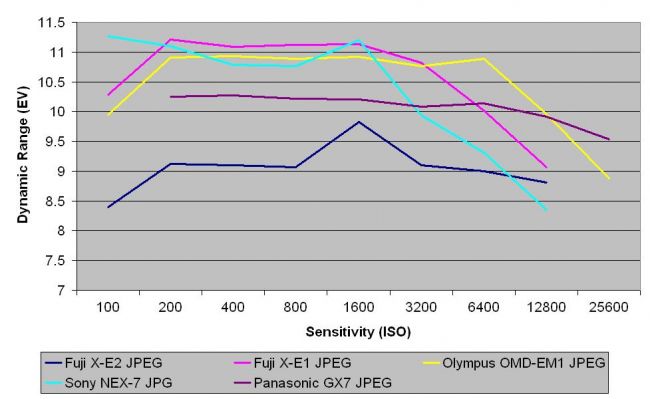
Dynamic range of JPG
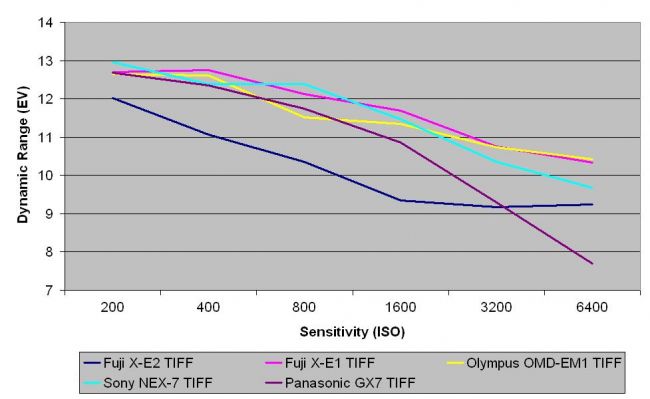
Dynamic range of RAW (after conversion to TIFF)
source: Techradar
Photographers, a few months after buying a new camera, already speculate about the properties of the next model, but often aren’t willing to invest the time and effort to learn to expose and edit (develop, if you like) photographs properly. I don’t remember anyone impatiently awaiting a new Praktica, but I do remember that for photos intended for professional printing everyone preferred to reach for positive film, because it had nicer colours, but at the same time had a lower range than negative film and therefore had to be exposed as precisely as possible. And just as magic was and still is worked in developing, digital photographs are helped along in editing on the computer.
In the days of my Nikons I shot RAW as a matter of principle; I wasn’t satisfied with JPG photos. I automatically continued that after switching to Fuji, until it dawned on me how good the JPG outputs are. For most scenes I shoot, and with my way of processing, JPG of this quality is enough for me. I save space on cards and on disk, and I save time copying, browsing and editing. When I feel the need, I switch to RAW, but mostly I don’t feel it. The quality I work with is amply enough for the internet, for prints in books or magazines and enough even for really big enlargements (60×40 up to 150×100).
If you know that and why you need RAW, that’s fine. But if you shoot RAW only because you were advised to, try to think about whether it isn’t unnecessary for you.
And above all don’t forget to shoot, the rest is secondary…
A lovely sunny day, and maybe we’ll meet at one of the upcoming events 🙂