This page was translated by AI. Please be forgiving of any mistakes.
‹ Photo Notes · 29 března, 2014
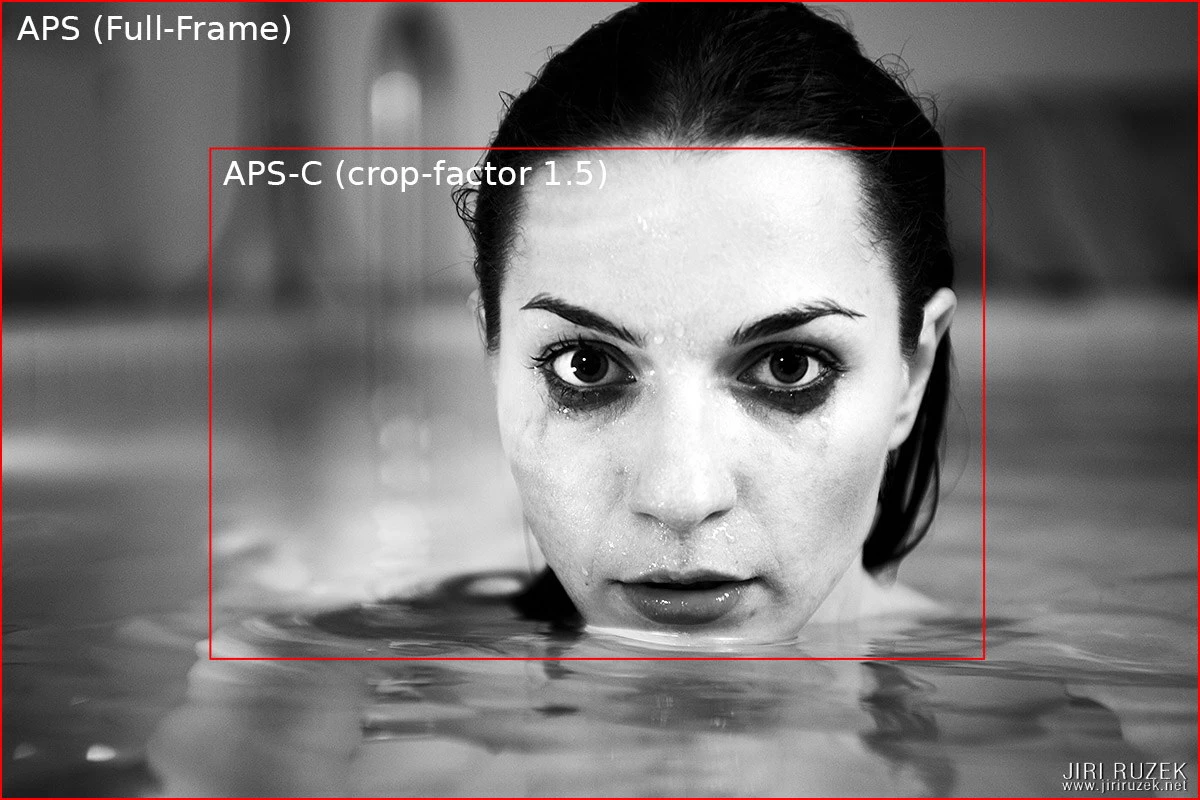
PetaPixel, a website focused on photography, yesterday published an article with a video in which a photographer tried to explain the term „crop factor“ and the difference between a full-frame image sensor and smaller sensors. Unfortunately he didn’t quite succeed and in his video repeated a number of common misconceptions. But he dressed and tanned nicely for it (I have something to learn:)
What is full-frame?
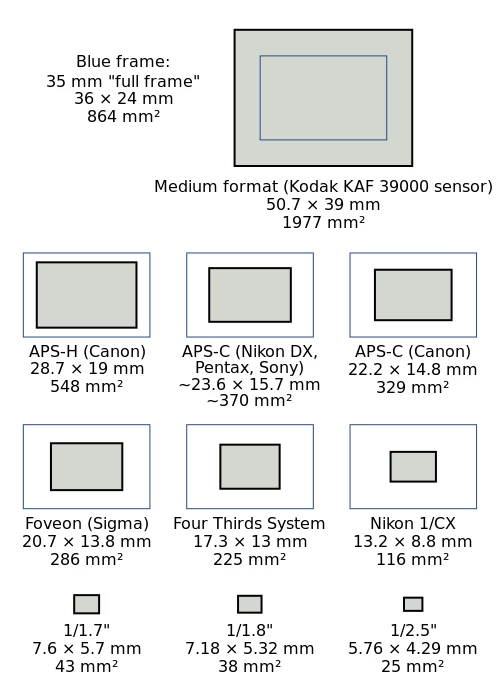
Full-frame is, in photographic jargon, the designation of a camera whose image sensor has the size of a 35mm film frame, i.e. 36×24 mm. Whether it differs somewhere by a millimetre isn’t all that important; we also give a little extra in a restaurant…
We find it in higher-class cameras, hence with a higher price.
What is APS-C?
APS-C (Advanced Photo System type-C) is an image sensor roughly the size of two thirds of the 35mm film frame (full-frame). Again I write roughly, because manufacturers commonly support their own standards and the sensor size varies approximately between 20.7×13.8 mm and 28.7×19.1 mm.
There are other formats, but I won’t make it more complicated than necessary.
What is crop factor?
The English word crop means cut or section – we’ll start from that. It is precisely the neglect of this simple fact that brings so many inconsistencies and misconceptions into the subject. Misconceptions connected mainly with lenses, their properties, behaviour and use.
I already wrote that sensor dimensions differ by manufacturer and thereby the value of the crop factor differs too. For example the crop factor of Canon APS-C cameras is 1.6, for Nikon or Fujifilm instruments it is 1.5 (that is easier to calculate with and so I’ll use a crop factor of 1.5 as the example).
Let’s watch the mentioned video and then move on to the misconceptions.
Misconceptions around the crop factor
100 mm on APS-C = 150 mm on full-frame
This is the most common misconception. We multiply the focal length of the lens by the crop factor (here ×1.5) and then say that on a camera with a small sensor we have a lens with a focal length 1.5× larger.
It isn’t so; the focal length remains unchanged, we are still shooting with a 100mm lens, only the image is cropped (that’s where the crop comes in) and this cropped area of the image corresponds to the area that a lens 1.5× longer, i.e. 150 mm, would photograph on a full-frame camera from the same distance. That distance is important.
In connection with other misconceptions you’ll understand why it is so.
Crop factor changes depth of field and bokeh
Wrong. The crop factor changes nothing. If you shoot from the same distance, the depth of field is the same too (you can see this in the first comparison photographs in the mentioned video as well).
Depth of field is influenced by:
- the focal length of the lens
- the f-number
- the distance of the last lens element from the image medium
- the distance from the photographed object
The focal length is the same (in our case 100 mm); the crop factor doesn’t change it. There is no reason to change the aperture value. The distance of the last element from the sensor is smaller on APS-C cameras, but the sensor itself is also smaller (notice how, with the size of the medium – 35mm film, medium, large format – the distance and thereby the overall size of the camera grow). And if we stand in the same place, the photographed object is equally far away, so the resulting photograph has the same depth of field.
So we have the same but cropped image.
F1.2 on APS-C = F1.8 on full-frame
Again a misconception. The lens speed, or aperture, remains the same in relation to the size of the image sensor. That is, if for an APS-C sensor we use a lens intended for APS-C and for full-frame we use a 35mm-format lens (medium-format for medium format etc.). It is logical that a small APS-C lens, fully adequate for a small sensor, will not be sufficient for full format, so its speed will have to be regarded as lower there.
Crop factor changes perspective
This isn’t true either (see the mentioned comparison photographs in the video). A lens with the same focal length and the same distance of the photographed objects guarantees the same perspective on full-frame and on APS-C.
So what changes?
Only the crop that we see and photograph changes. The term crop factor explains it all by itself.
And where do all those misconceptions come from?
It’s simple. I mentioned above that the distance from the object we photograph is important. And if we want not just a crop but a photograph that covers the same angle of view as full-frame, we must step further back from the object with the APS-C camera. That changes the perspective and also the depth of field. With perspective we unfortunately can do nothing, but we open the aperture by two numbers (if there’s room) and get a similar image to that from a full-frame camera. Except for that damned perspective.
And when we say that a 100mm lens on APS-C is like 150 mm on full-frame, it means that its crop corresponds to the angle of view of a 150mm lens.
That’s all. Capisci? 🙂
However, there are far more important and more interesting things in photography; we can talk about those at the next nude photography workshop